VTONQA: A Multi-Dimensional Quality Assessment Dataset for Virtual Try-on
Analysis of the VTONQA dataset, the first multi-dimensional quality assessment benchmark for Virtual Try-On (VTON) images, including dataset construction, model benchmarking, and future directions.
Home »
Documentation »
VTONQA: A Multi-Dimensional Quality Assessment Dataset for Virtual Try-on
1. Introduction & Overview
Image-based Virtual Try-On (VTON) technology has become a cornerstone of digital fashion and e-commerce, enabling users to visualize garments on themselves virtually. However, the perceptual quality of synthesized images varies significantly across different models, often plagued by artifacts like garment distortion, body part inconsistencies, and blurring. The lack of a standardized, human-perception-aligned benchmark has been a major bottleneck for both evaluating existing models and guiding future development.
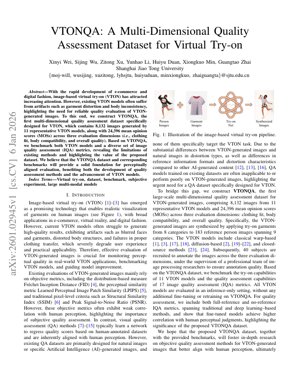
The VTONQA dataset, introduced by researchers from Shanghai Jiao Tong University, directly addresses this gap. It is the first large-scale, multi-dimensional quality assessment dataset specifically designed for VTON-generated images.
Evaluation Dimensions: 3 (Clothing Fit, Body Compatibility, Overall Quality)
Annotators: 40 subjects, supervised by experts
2. The VTONQA Dataset
The VTONQA dataset is meticulously constructed to provide a comprehensive and reliable benchmark for the VTON community.
2.1 Dataset Construction & Scale
The dataset is built upon a diverse foundation: 183 reference person images across 9 categories and garments from 8 clothing categories. These are processed through 11 representative VTON models, encompassing classical warp-based methods (e.g., CP-VTON, ACGPN), cutting-edge diffusion-based approaches (e.g., Stable Diffusion fine-tunes), and proprietary closed-source models, generating the final 8,132 try-on images. This diversity ensures the benchmark's robustness and generalizability.
2.2 Multi-Dimensional Annotation
Moving beyond a single "overall quality" score, VTONQA introduces a nuanced, multi-dimensional assessment framework. Each image is annotated with three separate Mean Opinion Scores (MOS):
Clothing Fit: Evaluates how naturally and accurately the garment conforms to the body's shape and pose.
Body Compatibility: Assesses the preservation of the original person's identity, skin texture, and body structure, avoiding artifacts like distorted limbs or blurred faces.
Overall Quality: A holistic score reflecting the general visual appeal and realism of the synthesized image.
This tripartite scoring system is crucial because a model might excel at garment transfer but fail at preserving facial details, a nuance missed by a single score.
3. Benchmarking & Experimental Results
Using VTONQA, the authors conduct extensive benchmarking across two axes: the performance of VTON models themselves and the efficacy of existing Image Quality Assessment (IQA) metrics on this novel domain.
3.1 VTON Model Benchmark
All 11 models are evaluated in an inference-only setting on the VTONQA images. The results reveal clear performance hierarchies. Generally, modern diffusion-based models tend to achieve higher scores in terms of visual fidelity and artifact reduction compared to older warp-based paradigms. However, the benchmark also exposes specific failure modes unique to each architecture, providing clear targets for improvement. For instance, some models may score well on "Clothing Fit" but poorly on "Body Compatibility," indicating a trade-off.
3.2 IQA Metric Evaluation
A key finding is the poor correlation between traditional full-reference IQA metrics (e.g., PSNR, SSIM) and human MOS for VTON images. These pixel-level metrics are ill-suited for evaluating semantic-level distortions like garment style preservation or identity consistency. Even learned perceptual metrics like LPIPS and FID, while better, show significant room for improvement. The paper demonstrates that IQA models fine-tuned on VTONQA data achieve substantially higher correlation with human judgment, underscoring the domain-specific nature of the problem and the value of the dataset for training specialized evaluators.
Chart Insight (Hypothetical based on paper description): A bar chart comparing the Spearman Rank Order Correlation (SROCC) of various IQA metrics against human MOS on VTONQA would likely show traditional metrics (PSNR, SSIM) with very low bars (~0.2-0.3), general perceptual metrics (LPIPS, FID) with moderate bars (~0.4-0.6), and metrics fine-tuned on VTONQA with the highest bars (~0.7-0.8+), visually proving the dataset's necessity.
4. Technical Details & Analysis
4.1 Core Insight & Logical Flow
Core Insight: The VTON field has been optimizing for the wrong targets. Chasing lower FID or higher SSIM is a fool's errand if those numbers don't translate to a convincing, artifact-free try-on for the end-user. VTONQA's fundamental contribution is shifting the paradigm from computational similarity to perceptual realism as the north star.
Logical Flow: The paper's argument is razor-sharp: 1) VTON is commercially critical but quality is inconsistent. 2) Existing evaluation is broken (weak correlation with human judgment). 3) Therefore, we built a massive, human-annotated dataset (VTONQA) that defines quality across three specific axes. 4) We use it to prove point #2 by benchmarking current models and metrics, exposing their flaws. 5) We provide the dataset as a tool to fix the problem, enabling the development of perceptually-aligned models and evaluators. This is a classic "identify gap, build bridge, prove value" research narrative executed effectively.
4.2 Strengths & Flaws
Strengths:
Pioneering & Well-Executed: Fills a glaring, fundamental gap in the VTON ecosystem. The scale (8k+ images, 24k+ annotations) and multi-dimensional design are commendable.
Actionable Benchmarking: The side-by-side evaluation of 11 models provides an immediate "state-of-the-art" landscape, useful for both researchers and practitioners.
Exposes Metric Failure: The demonstration that off-the-shelf IQA metrics fail on VTON is a critical wake-up call for the community, similar to how the original CycleGAN paper exposed the limitations of prior unpaired image translation methods.
Flaws & Open Questions:
The "Black Box" of Closed-Source Models: Including proprietary models is practical but limits reproducibility and deep analysis. We don't know why model X fails, only that it does.
Static Snapshot: The dataset is a snapshot of models circa its creation. The rapid evolution of diffusion models means new SOTA models may already exist that aren't represented.
Subjectivity in Annotation: While supervised, MOS inherently contains subjective variance. The paper could benefit from reporting inter-annotator agreement metrics (e.g., ICC) to quantify annotation consistency.
4.3 Actionable Insights
For different stakeholders:
VTON Researchers: Stop using FID/SSIM as your primary success metric. Use VTONQA's MOS as your validation target, or better yet, use the dataset to train a dedicated No-Reference IQA (NR-IQA) model as a proxy for human evaluation during development.
Model Developers (Industry): Benchmark your model against VTONQA's leaderboard. If you're lagging in "Body Compatibility," invest in identity preservation modules. If "Clothing Fit" is low, focus on geometric warping or diffusion guidance.
E-commerce Platforms: The multi-dimensional scores can directly inform user interface design. For example, prioritize showing try-on results from models with high "Overall Quality" and "Body Compatibility" scores to boost user trust and conversion.
The dataset is not just an academic exercise; it's a practical tuning fork for the entire industry.
Technical Formalism & Metrics
The evaluation relies on standard correlation metrics between predicted scores (from IQA metrics or model outputs) and ground-truth MOS. The key metrics are:
Spearman’s Rank Order Correlation Coefficient (SROCC): Measures monotonic relationship. Calculated as $\rho = 1 - \frac{6 \sum d_i^2}{n(n^2 - 1)}$, where $d_i$ is the difference in ranks for the $i$-th sample. Robust to non-linear relationships.
Pearson Linear Correlation Coefficient (PLCC): Measures linear correlation after a non-linear regression (e.g., logistic) mapping. Calculated as $r = \frac{\sum (x_i - \bar{x})(y_i - \bar{y})}{\sqrt{\sum (x_i - \bar{x})^2 \sum (y_i - \bar{y})^2}}$.
A high SROCC/PLCC (close to 1) indicates an IQA metric's prediction aligns well with human perception order and magnitude.
5. Analysis Framework & Case Study
Framework for Evaluating a New VTON Model Using VTONQA Principles:
Data Preparation: Select a diverse set of person and garment images not in the original VTONQA test set to ensure fairness.
Image Synthesis: Run your model to generate try-on images.
Multi-Dimensional Assessment (Proxy): Instead of costly human evaluation, use two proxies:
A) Fine-tuned NR-IQA Model: Employ an IQA model (e.g., based on ConvNeXt or ViT) that has been fine-tuned on the VTONQA dataset to predict MOS for each of the three dimensions.
B) Targeted Metric Suite: Compute a basket of metrics: FID/LPIPS for general distribution/texture, a face recognition similarity score (e.g., ArcFace cosine) for Body Compatibility, and a garment segmentation accuracy metric (e.g., mIoU between warped garment mask and rendered area) for Clothing Fit.
Benchmark Comparison: Compare your model's proxy scores against the published VTONQA benchmarks for the 11 existing models. Identify your relative strengths and weaknesses.
Iterate: Use the weak dimension(s) to guide model architecture or training loss adjustments.
Case Study Example: A team develops a new diffusion-based VTON model. Using the framework, they find its VTONQA-proxy scores are: Clothing Fit: 4.1/5, Body Compatibility: 3.0/5, Overall: 3.5/5. Comparison shows it beats all warp-based models in Clothing Fit but lags behind top diffusion models in Body Compatibility. The insight: their model loses facial detail. The action: they incorporate an identity preservation loss term (e.g., a perceptual loss on face crops using a pre-trained network) in the next training cycle.
6. Future Applications & Directions
The VTONQA dataset opens several compelling avenues for future work:
Perceptual-Loss Driven Training: The most direct application is using the MOS data to train VTON models directly. A loss function can be designed to minimize the distance between a model's output and a high MOS score, potentially using a GAN discriminator or a regression network trained on VTONQA as a "perceptual critic."
Specialized NR-IQA Models for VTON: Developing lightweight, efficient NR-IQA models that can predict VTONQA-style scores in real-time. These could be deployed on e-commerce platforms to automatically filter out low-quality try-on results before they reach the user.
Explainable AI for VTON Failures: Extending beyond a score to explain why an image received a low score (e.g., "garment distortion on left sleeve," "face identity mismatch"). This involves combining quality assessment with spatial attribution maps.
Dynamic & Interactive Assessment: Moving from static image assessment to video-based try-on sequences, where temporal consistency becomes a crucial fourth dimension of quality.
Integration with Large Multimodal Models (LMMs): Leveraging models like GPT-4V or Gemini to provide natural language critiques of try-on images, aligning with the multi-dimensional framework (e.g., "The shirt fits well but the pattern is distorted on the shoulder."). VTONQA could serve as fine-tuning data for such LMMs.
7. References
Wei, X., Wu, S., Xu, Z., Li, Y., Duan, H., Min, X., & Zhai, G. (Year). VTONQA: A Multi-Dimensional Quality Assessment Dataset for Virtual Try-on. Conference/Journal Name.
Isola, P., Zhu, J. Y., Zhou, T., & Efros, A. A. (2017). Image-to-image translation with conditional adversarial networks. In Proceedings of the IEEE conference on computer vision and pattern recognition (pp. 1125-1134). [External - Foundational GAN work]
Zhu, J. Y., Park, T., Isola, P., & Efros, A. A. (2017). Unpaired image-to-image translation using cycle-consistent adversarial networks. In Proceedings of the IEEE international conference on computer vision (pp. 2223-2232). [External - CycleGAN, relevant for unpaired translation analogy]
Heusel, M., Ramsauer, H., Unterthiner, T., Nessler, B., & Hochreiter, S. (2017). GANs trained by a two time-scale update rule converge to a local nash equilibrium. Advances in neural information processing systems, 30.
Zhang, R., Isola, P., Efros, A. A., Shechtman, E., & Wang, O. (2018). The unreasonable effectiveness of deep features as a perceptual metric. In Proceedings of the IEEE conference on computer vision and pattern recognition (pp. 586-595).
Wang, Z., Bovik, A. C., Sheikh, H. R., & Simoncelli, E. P. (2004). Image quality assessment: from error visibility to structural similarity. IEEE transactions on image processing, 13(4), 600-612.
OpenAI. (2023). GPT-4V(ision) System Card. OpenAI. [External - LMM reference]
Google. (2023). Gemini: A Family of Highly Capable Multimodal Models. arXiv preprint. [External - LMM reference]
Original Analysis: The Perceptual Imperative in Virtual Try-On
The VTONQA dataset represents a pivotal, and arguably overdue, maturation in the field of virtual try-on research. For years, the community has operated under a significant misalignment: optimizing for mathematical proxies of image quality rather than the end-user's perceptual experience. This paper correctly identifies that metrics like FID and SSIM, while useful for tracking general generative model progress, are woefully inadequate for the specific, semantically-rich task of trying on clothes. A blurry face might only slightly hurt FID but completely destroys user trust—a disconnect VTONQA directly remedies.
The paper's tripartite quality decomposition (Fit, Compatibility, Overall) is its most astute conceptual contribution. It recognizes that VTON quality isn't monolithic. This mirrors lessons from other AI-generated content domains. For instance, in AI-generated art, separate assessments for composition, style adherence, and coherence are needed. By providing granular scores, VTONQA doesn't just say a model is "bad"; it diagnoses why—is the sweater pixelated, or does it make the user's arm look unnatural? This level of diagnostic power is essential for iterative engineering.
The benchmarking results, which show the failure of off-the-shelf IQA metrics, should be a stark warning. It echoes the historical lesson from the CycleGAN paper, which showed that previous unpaired translation methods were often evaluating themselves on flawed, task-agnostic metrics. The field only advanced when proper, task-specific evaluation was established. VTONQA aims to be that foundational evaluation standard. The potential to use this data to train dedicated "VTON quality critics"—akin to Discriminators in GANs but guided by human perception—is immense. One can envision these critics being integrated into the training loop of future VTON models as a perceptual loss, a direction strongly hinted at by the fine-tuning experiments on IQA metrics.
Looking forward, the logical extension is into dynamic and interactive evaluation. The next frontier isn't a static image but a video try-on or a 3D asset. How do we assess the quality of fabric drape in motion or the preservation of identity across different angles? VTONQA's multi-dimensional framework provides a template for these future benchmarks. Furthermore, the rise of Large Multimodal Models (LMMs) like GPT-4V and Gemini, as noted in the paper's index terms, presents a fascinating synergy. These models can be fine-tuned on VTONQA's image-score pairs to become automated, explainable quality assessors, providing not just a score but a textual rationale ("the sleeve pattern is stretched"). This moves quality assessment from a black-box number to an interpretable feedback tool, accelerating research and development even further. In conclusion, VTONQA is more than a dataset; it's a correction to the field's trajectory, firmly re-centering research and development on the only metric that ultimately matters: human perception.