1. Table of Contents
- 1.1 Introduction & Overview
- 1.2 Core Methodology
- 1.2.1 Structure-Aware Guidance
- 1.2.2 Appearance Guidance via ViT
- 1.3 Technical Details & Mathematical Formulation
- 1.4 Experimental Results & Analysis
- 1.5 Key Insights & Analyst's Perspective
- 1.6 Analysis Framework: Example Case
- 1.7 Future Applications & Directions
- 1.8 References
1.1 Introduction & Overview
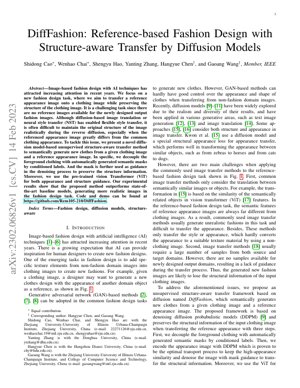
This document analyzes the paper "DiffFashion: Reference-based Fashion Design with Structure-aware Transfer by Diffusion Models." The work addresses a critical challenge in AI-driven fashion design: transferring the appearance from a reference image (which can be from a non-fashion domain, like an animal or landscape) onto a target clothing item while meticulously preserving the clothing's original structure (shape, cut, folds). This is an unsupervised, zero-shot task, meaning no paired examples of the desired output exist for training.
Traditional Neural Style Transfer (NST) and even recent diffusion-based image translation methods often fail in this scenario. They either struggle with large semantic gaps between domains (e.g., zebra stripes to a dress) or fail to maintain structural fidelity, resulting in distorted or unrealistic garments. DiffFashion proposes a novel solution by decoupling structure and appearance guidance within a diffusion model framework.
1.2 Core Methodology
DiffFashion's architecture is built upon a denoising diffusion probabilistic model (DDPM). Its innovation lies in how it conditions the reverse denoising process.
1.2.1 Structure-Aware Guidance
The model first automatically generates a semantic mask for the foreground clothing in the target image. This mask, which outlines the garment's structure, is then used as a conditioning signal during the denoising process. By injecting this structural prior, the model is explicitly guided to generate pixels only within the defined clothing region, preserving the original silhouette and cut. This is a more direct and robust approach than relying solely on feature-space similarities, which can be unstable across disparate domains.
1.2.2 Appearance Guidance via ViT
For appearance transfer, DiffFashion leverages a pre-trained Vision Transformer (ViT). The features extracted from the reference appearance image by the ViT are used to steer the denoising process towards the desired texture, color, and pattern. The key is applying this guidance in a semantically meaningful way, aligned with the structural mask, to ensure the "zebra stripes" or "marble texture" correctly conform to the fabric's folds and drape.
1.3 Technical Details & Mathematical Formulation
The core of the method is a conditional diffusion process. Given a noisy image $x_t$ at timestep $t$, a clothing structure mask $M$, and a reference appearance image $I_{ref}$, the model learns to predict the noise $\epsilon_\theta$ with the conditioning:
$\epsilon_\theta = \epsilon_\theta(x_t, t, M, \phi(I_{ref}))$
where $\phi(\cdot)$ represents the feature extraction function of the pre-trained ViT. The training objective is a modified version of the standard diffusion loss, ensuring the model learns to denoise the image towards a target that respects both the structural constraint $M$ and the appearance features from $I_{ref}$.
The denoising step can be conceptualized as:
$x_{t-1} \sim \mathcal{N}(\mu_\theta(x_t, t, M, \phi(I_{ref})), \Sigma_\theta(x_t, t))$
where the mean $\mu_\theta$ is conditioned on both structure and appearance signals.
1.4 Experimental Results & Chart Description
The paper presents comparative results against several strong baselines, including GAN-based methods (like CycleGAN) and other diffusion-based image translation models.
Qualitative Results (Implied from Text): The generated images likely show a side-by-side comparison. A target column shows input clothing (e.g., a plain dress). A reference column shows non-fashion images (e.g., a zebra, a leopard, a cracked earth texture). The DiffFashion output column would demonstrate the successful transfer of zebra stripes onto the dress, maintaining its original neckline, sleeve length, and body shape realistically, with patterns bending naturally at seams and folds. In contrast, baseline outputs might show distorted dress shapes, patterns that ignore garment structure, or failure to capture the reference appearance accurately.
Quantitative Metrics: The paper likely employs standard image generation metrics such as Fréchet Inception Distance (FID) to measure realism and distribution alignment, and Learned Perceptual Image Patch Similarity (LPIPS) or a custom structural similarity metric to assess how well the original clothing structure is preserved. The text states DiffFashion "outperforms state-of-the-art baseline models," implying superior scores on these metrics.
1.5 Key Insights & Analyst's Perspective
Core Insight: DiffFashion isn't just another style transfer toy; it's a pragmatic engineering solution to a real-world industrial problem—bridging the "semantic gap" in generative AI. The fashion industry craves novelty but is constrained by physical form (garment structure). This work correctly identifies that prior art, whether pioneering NST or robust frameworks like CycleGAN (Zhu et al., 2017), fails when the source (zebra) and target (dress) domains are semantically orthogonal. Their failure isn't a lack of power but a misalignment of objectives. DiffFashion's core insight is the decoupling and explicit reinforcement of structure and appearance as separate, controllable conditioning signals within the powerful but chaotic latent space of a diffusion model.
Logical Flow: The logic is admirably straightforward: 1) Isolate the garment's form (via segmentation). 2) Isolate the reference's texture/color essence (via a general-purpose feature extractor like ViT). 3) Use the former as a hard spatial constraint and the latter as a soft semantic guide during the diffusion denoising process. This flow moves from problem decomposition to a fused solution, mirroring how a human designer might think: "Here is the dress shape, here is the pattern I want, now apply the latter to the former."
Strengths & Flaws: The primary strength is its demonstrated effectiveness in a challenging zero-shot setting, a significant leap over methods requiring aligned datasets. The use of off-the-shelf components (ViT, segmentation models) makes it relatively accessible. However, the analysis is skeptical of its scalability. The quality is heavily dependent on the accuracy of the initial automatic segmentation—a flawed mask would propagate errors. Furthermore, while it handles "appearance," the control over how that appearance maps to structure (e.g., pattern scale, orientation on specific garment parts) seems limited. It's a powerful brush, but not yet a precision tool. The comparison, while claiming SOTA, would be more convincing with ablations against more recent diffusion-based controllers like ControlNet.
Actionable Insights: For AI researchers, the takeaway is the validation of "conditioning decoupling" as a strategy for complex generation tasks. For the fashion tech industry, this is a viable prototype for a design inspiration tool. The immediate next step isn't just better metrics, but user studies with professional designers. Does this speed up their workflow? Does it generate usable, manufacturable designs? The technology should be integrated into existing CAD pipelines, perhaps allowing designers to sketch a structure and drag-and-drop a reference image for instant visualization. The business model isn't in replacing designers, but in augmenting their creativity and reducing iteration time.
1.6 Analysis Framework: Example Case
Scenario: A sportswear brand wants to design a new line of running tights inspired by natural elements.
Inputs:
- Target Structure Image: A 3D model render or flat sketch of a basic running tight.
- Reference Appearance Image: A photo of cracked desert mud, showing intricate patterns and earthy tones.
DiffFashion Process Analysis:
- Structure Extraction: The model (or a pre-processor) segments the running tight from the background, creating a precise binary mask defining the garment area.
- Appearance Encoding: The desert mud photo is fed into the pre-trained ViT. The model extracts high-level features representing the color palette (browns, tans), the texture (cracked, rough), and the pattern geometry (irregular polygonal shapes).
- Conditional Denoising: Starting from noise, the diffusion model iteratively denoises an image. At each step:
- The structure mask acts as a gate: "Only generate pixels within the tight region."
- The ViT features act as a guide: "Push the generated pixels towards looking like the color and texture of cracked mud."
- Output: A photorealistic image of the running tight, perfectly conforming to the original cut and seams, now covered in a pattern that convincingly mimics cracked earth, with the pattern naturally stretching and compressing around the knee and thigh areas.
Value: This transforms an abstract inspiration (desert) into a concrete, visualizable design in seconds, bypassing hours of manual digital painting or texture mapping.
1.7 Future Applications & Directions
Short-term (1-2 years):
- Digital Fashion & NFT Design: Rapid prototyping of unique digital garments for virtual worlds and digital collectibles.
- E-commerce Personalization: Allowing customers to visualize custom patterns on base clothing models.
- Augmented Reality Try-On: Generating realistic texture variations for AR clothing visualization apps.
Mid-term (3-5 years):
- Integration with 3D Garment Simulation: Coupling with physics-based simulation software to see how generated fabrics drape and move.
- Multi-modal Conditioning: Accepting text prompts ("make it look like stormy clouds") alongside reference images for blended inspiration.
- Material-aware Generation: Incorporating physical material properties (e.g., silk vs. denim) to make the appearance transfer physically plausible.
Long-term & Research Directions:
- Bidirectional Design: From generated 2D image to 3D garment pattern pieces for physical manufacturing.
- Sustainable Design: Using AI to create visually appealing designs that also optimize for material waste reduction in cutting.
- Cross-domain Generalization: Applying the structure-appearance decoupling principle to other fields like interior design (applying a texture to a specific furniture shape) or product design.
1.8 References
- Zhu, J. Y., Park, T., Isola, P., & Efros, A. A. (2017). Unpaired Image-to-Image Translation using Cycle-Consistent Adversarial Networks. In Proceedings of the IEEE International Conference on Computer Vision (ICCV).
- Ho, J., Jain, A., & Abbeel, P. (2020). Denoising Diffusion Probabilistic Models. In Advances in Neural Information Processing Systems (NeurIPS).
- Dosovitskiy, A., et al. (2020). An Image is Worth 16x16 Words: Transformers for Image Recognition at Scale. In International Conference on Learning Representations (ICLR).
- Rombach, R., Blattmann, A., Lorenz, D., Esser, P., & Ommer, B. (2022). High-Resolution Image Synthesis with Latent Diffusion Models. In Proceedings of the IEEE/CVF Conference on Computer Vision and Pattern Recognition (CVPR).
- Kwon, G., & Ye, J. C. (2022). Diffusion-based Image Translation using Disentangled Style and Content Representation. arXiv preprint arXiv:2209.15264.
- OpenAI. (2024). DALL-E 3 System Card. OpenAI. [https://openai.com/index/dall-e-3-system-card/]