Hierarchical Discrete Lattice Assembly for Scalable Macroscale Structures
A research paper presenting a novel approach for large-scale digital fabrication using hierarchical lattice blocks and mobile assembly robots, with a live digital twin for coordination.
Home »
Documentation »
Hierarchical Discrete Lattice Assembly for Scalable Macroscale Structures
1. Introduction
This paper addresses a fundamental bottleneck in digital fabrication: the inability of machines to produce structures larger than themselves. While desktop-scale fabrication is mature, scaling to architectural or human scales presents significant challenges in cost, complexity, and reliability. Current methods often rely on manual assembly of pre-fabricated parts or large, immobile industrial robots, lacking a clear path to truly scalable, autonomous construction.
The authors propose Hierarchical Discrete Lattice Assembly (HDLA) as a solution. This approach combines a modular, interlocking lattice material system with a cohort of simple, mobile assembly robots. The key innovation lies in a hierarchical workflow: a target structure is first voxelized and populated with an architected lattice. These voxels are then aggregated into larger, manufacturable blocks (tens of centimeters). Mobile robots then traverse and assemble these blocks into meter-scale structures, coordinated by a live digital twin simulation.
This work aims to bridge the gap between the geometric freedom of digital design and the practical constraints of physical assembly at large scales, moving towards scale-agnostic and autonomous fabrication systems.
2. Methodology
The HDLA pipeline is a multi-stage process designed to decompose complex designs into robotically assemblable components.
2.1. Voxelization and Lattice Design
The process begins with a 3D mesh (e.g., STL file) of the target structure. This mesh is discretized into a volumetric grid (voxelization). Each voxel is then internally structured with a predetermined architected lattice. The lattice geometry is chosen to provide specific mechanical properties (stiffness, strength-to-weight ratio) and to feature interlocking connectors on its faces, enabling robust block-to-block attachment without external fasteners.
This step translates a continuous, arbitrary geometry into a discrete, assemblable representation, akin to converting a bitmap image into Lego bricks but with engineered internal structures.
2.2. Hierarchical Blocking Strategy
A core contribution is the aggregation of individual lattice voxels into larger hierarchical blocks. A clustering algorithm groups contiguous voxels into blocks on the scale of tens of centimeters. This serves two critical purposes:
Manufacturing Efficiency: These larger blocks can be produced efficiently using standard desktop-scale 3D printers or other digital fabrication tools, which excel at creating complex geometries at this scale.
Assembly Throughput: Robots manipulate and place these pre-assembled blocks rather than individual tiny voxels, dramatically increasing the speed of large-scale construction.
The blocking algorithm must balance block size for handling against the need to approximate the target geometry faithfully.
2.3. Robotic Assembly System
The assembly is performed by a team of mobile relative robots. These robots are "relative" in that they navigate across the growing structure itself, not on a fixed factory floor. The paper introduces a new modular robot design optimized for handling the hierarchical blocks.
Key robotic capabilities include:
Traversal on the irregular surface of the partially built lattice structure.
Precise pick-and-place of blocks using the interlocking connectors.
Potential for local error correction through mechanical compliance and the interlocking design.
This approach avoids the need for massive gantry systems or robotic arms with enormous workspaces.
2.4. Live Digital Twin Simulation
Coordination is managed by a live digital twin—a real-time simulation of the physical assembly process. This tool serves multiple functions:
Global Path Planning: Computes optimal assembly sequences and robot trajectories to build the target structure.
Coordination & Control: Directs the multi-robot swarm, preventing collisions and managing task allocation.
Human-in-the-Loop Interaction: Allows designers to intervene, modify the plan, or interact with the simulation during assembly, enabling live design changes.
State Synchronization: The twin updates based on sensor feedback from the physical site, maintaining an accurate model of the build progress.
3. Technical Details & Mathematical Framework
The system's efficacy relies on several technical underpinnings:
Voxelization & Lattice Mechanics: The mechanical properties of the final structure derive from the lattice topology within each voxel. Using homogenization theory, the effective elastic tensor $\mathbf{C}^{\text{eff}}$ of the periodic lattice can be approximated. For a simple cubic lattice with beam elements, the effective stiffness can be related to the beam's Young's modulus $E$, cross-sectional area $A$, and length $l$ through relationships derived from periodic unit cell analysis.
Block Clustering Algorithm: The grouping of voxels into blocks can be formulated as an optimization problem. Let $V$ be the set of all voxels. The goal is to find a partition $\{B_1, B_2, ..., B_n\}$ of $V$ that minimizes a cost function $C$:
$$ C = \alpha \cdot \text{(Number of Blocks)} + \beta \cdot \text{(Surface Area of Blocks)} + \gamma \cdot \text{(Deviation from Target Geometry)} $$
where $\alpha, \beta, \gamma$ are weights balancing manufacturing cost, assembly interface complexity, and geometric fidelity.
Robot Path Planning: Planning on the growing structure is a dynamic graph search problem. The structure is represented as a graph $G_t = (N_t, E_t)$ at time $t$, where nodes $N_t$ are placed blocks and edges $E_t$ are traversable connections. Robot pathfinding uses algorithms like A* on this evolving graph, with constraints for robot stability and load capacity.
4. Experimental Results & Validation
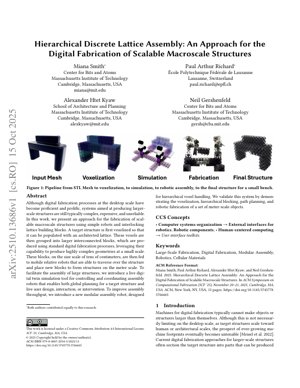
The authors validated the HDLA pipeline through the fabrication of meter-scale objects, including a bench (as referenced in Figure 1).
Key Results:
Successful Pipeline Execution: The complete workflow—from STL mesh to robotic assembly—was demonstrated, proving the concept's feasibility.
Structural Integrity: The interlocking lattice blocks produced stable, load-bearing structures without adhesive or external fasteners, validating the mechanical design of the connectors.
Robotic Assembly: The modular robots successfully traversed the structure and placed blocks according to the digital twin's plan. The live twin enabled monitoring and ad-hoc intervention.
Scalability Demonstration: By constructing meter-scale objects from centimeter-scale blocks using desk-sized robots, the hierarchical approach to scaling was physically realized.
Chart & Figure Description:Figure 1 in the PDF illustrates the end-to-end pipeline: 1) An STL mesh of a bench, 2) The mesh converted into a voxelized model, 3) A simulation view likely showing the assembly sequence or stress analysis, 4) A photo of a robotic arm or mobile robot placing a block, 5) The final fabricated bench structure. This figure is crucial as it visually summarizes the core contribution of the paper.
5. Analysis Framework: Core Insight & Critique
Core Insight: The MIT/EPFL team hasn't just built a bigger 3D printer; they've re-architected the very paradigm of digital fabrication at scale. The real breakthrough is the decoupling of manufacturing resolution from assembly scale through hierarchy. They leverage cheap, precise desktop fab for complex lattices, then delegate the "dumb" but large-scale task of stacking to simple robots. This is a masterstroke in systems thinking, reminiscent of the shift from monolithic supercomputers to distributed clusters. The live digital twin isn't just a fancy UI—it's the essential central nervous system that makes this distributed physical computation possible.
Logical Flow: The argument is compelling: 1) Big printers don't scale (footprint problem). 2) Swarm robotics promise scale but struggle with complexity and payload. 3) Solution: Embed complexity into the material system (lattice blocks), not the robots. 4) Use hierarchy to manage complexity. 5) Use a digital twin to manage the swarm. The flow from problem definition to technical solution is coherent and addresses the root causes, not just symptoms.
Strengths & Flaws:Strengths: The co-design of material and robot is exemplary. The interlocking mechanism enables error tolerance—a critical yet often overlooked feature for real-world deployment, as seen in successful robotic assembly systems like the MIT's Digital Construction Platform. The use of a live digital twin for coordination is state-of-the-art, aligning with Industry 4.0 principles.
Flaws & Gaps: The paper is conspicuously silent on economic viability. The energy and time cost of printing thousands of lattice blocks versus traditional concrete or steel methods is unaddressed. Material choice is also a black box—are these polymer lattices structurally sound for permanent architecture? There's no discussion of environmental degradation or long-term loading. Furthermore, the "simple" robots are likely highly specialized and not yet cheap. The scalability claim, while promising, is demonstrated only at the meter scale; the leap to building-scale introduces monumental challenges in wind loads, foundation integration, and safety certification that the paper doesn't touch.
Actionable Insights: For researchers: Focus on multi-material lattice blocks (e.g., with integrated wiring, insulation, plumbing) to increase functional value. Explore algorithmic fairness in swarm task allocation to prevent robot traffic jams. For industry: This tech is ripe for disaster response or temporary infrastructure first, not skyscrapers. Partner with material scientists to develop robust, recyclable block compositions. The immediate commercial path isn't selling construction systems, but licensing the digital twin coordination software as a platform for other robotic assembly applications.
6. Future Applications & Research Directions
The HDLA framework opens numerous avenues for future work and application:
In-Situ Space Construction: Deploying such a system from a lander to autonomously assemble habitats or radiation shields on the Moon or Mars using locally sourced regolith-based blocks.
Adaptive & Responsive Architecture: Structures could be designed for disassembly and reconfiguration. The digital twin could continuously monitor structural health and dispatch robots to replace damaged blocks or reinforce areas based on sensor data.
Multi-Functional Structures: Research into lattice blocks that serve as structural elements, thermal insulation, acoustic damping, and conduits for power/data/fluid distribution simultaneously.
Algorithmic Advancements: Developing more sophisticated AI for the digital twin, capable of real-time, adaptive planning in uncertain environments and optimizing for multiple objectives (speed, material use, energy consumption).
Material Science Integration: Exploring sustainable, high-strength materials for block production, including bio-based polymers, fiber-reinforced composites, or sintered granular materials.
Human-Robot Collaboration (HRC): Expanding the digital twin's role to orchestrate seamless collaboration between autonomous robots and human workers on the construction site.
7. References
Smith, M., Richard, P. A., Kyaw, A. H., & Gershenfeld, N. (2025). Hierarchical Discrete Lattice Assembly: An Approach for the Digital Fabrication of Scalable Macroscale Structures. ACM Symposium on Computational Fabrication (SCF '25).
Jenett, B., Cameron, C., Tourlomousis, F., Rubio, A. P., Ochalek, M., & Gershenfeld, N. (2019). Discretely assembled mechanical metamaterials. Science Robotics, 5(41). [External - Demonstrates error-correcting assembly via material design]
Petersen, K. H., Napp, N., Stuart-Smith, R., Rus, D., & Kovac, M. (2019). A review of collective robotic construction. Science Robotics, 4(28). [External - Authoritative review of the field]
Keating, S. J., Leland, J. C., Cai, L., & Oxman, N. (2017). Toward site-specific and self-sufficient robotic fabrication on architectural scales. Science Robotics, 2(5). [External - MIT's Digital Construction Platform, a related large-scale fab approach]
Gibson, L. J., & Ashby, M. F. (1997). Cellular Solids: Structure and Properties. Cambridge University Press. [External - Foundational text on the mechanics of lattice materials]
Melenbrink, N., Werfel, J., & Menges, A. (2021). On-site autonomous construction robots: Towards unsupervised building. Automation in Construction, 119. [External - Discusses challenges in autonomous construction]