1. Introduction & Related Work
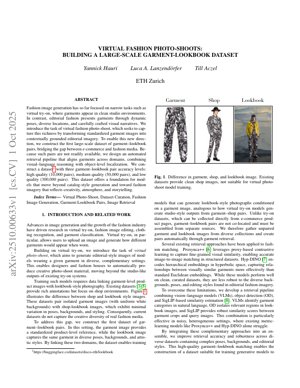
Current fashion image generation research, particularly in virtual try-on, operates within a constrained paradigm: placing garments on models in clean, studio-like environments. This paper, "Virtual Fashion Photo-Shoots: Building a Large-Scale Garment-Lookbook Dataset," introduces a more ambitious task: the virtual photo-shoot. This task aims to transform standardized product images into editorial-style imagery characterized by dynamic poses, diverse locations, and crafted visual narratives.
The core challenge is the lack of paired data. Existing datasets like DeepFashion2 and VITON link product images to "shop" images—clean, front-facing shots on models with simple backgrounds. These lack the creative diversity of real fashion media (lookbooks, magazine spreads). The authors identify this as a critical gap, preventing models from learning the translation from product catalog to artistic presentation.
2. Methodology & Dataset Construction
To enable the virtual photo-shoot task, the authors construct the first large-scale dataset of garment-lookbook pairs. Since such pairs do not naturally co-exist, they developed an automated retrieval pipeline to align garments across the e-commerce and editorial domains.
2.1 The Garment-Lookbook Pairing Problem
The problem is defined as: given a query garment image $I_g$ (clean background), retrieve the most similar garment instance from a large, unlabeled collection of lookbook images $\{I_l\}$. The challenge is the domain gap: differences in viewpoint, lighting, occlusion, background clutter, and artistic post-processing between $I_g$ and $I_l$.
2.2 Automated Retrieval Pipeline
The pipeline is an ensemble designed for robustness in noisy, heterogeneous data. It combines three complementary techniques:
2.2.1 Vision-Language Model (VLM) Categorization
A VLM (e.g., CLIP) is used to generate a natural language description of the garment category (e.g., "a red floral midi dress"). This provides a high-level semantic filter, narrowing the search space within the lookbook collection before fine-grained visual matching.
2.2.2 Object Detection (OD) for Region Isolation
An object detector (e.g., YOLO, DETR) localizes the garment region within complex lookbook images. This step crops out the background and model, focusing the similarity computation on the garment itself, which is crucial for accuracy.
2.2.3 SigLIP-based Similarity Estimation
The core matching uses SigLIP (Sigmoid Loss for Language Image Pre-training), a contrastive vision-language model known for robust similarity scoring. The similarity $s$ between the query garment embedding $e_g$ and a cropped lookbook garment embedding $e_l$ is computed, often using a cosine similarity metric: $s = \frac{e_g \cdot e_l}{\|e_g\|\|e_l\|}$. The pipeline ranks lookbook crops by this score.
2.3 Dataset Composition & Quality Tiers
The resulting dataset, hosted on Hugging Face, is stratified into three quality tiers based on retrieval confidence scores:
High Quality
10,000 pairs
Manually verified or highest confidence matches. Suitable for model training and evaluation.
Medium Quality
50,000 pairs
High-confidence automated matches. Useful for pre-training or data augmentation.
Low Quality
300,000 pairs
Matches ya kwarara da kuma fadi. Yana ba da bayanai masu yawa da bambancin su don horar da kai ko horo mai ƙarfi.
Babban Fahimta: Wannan tsari na matakai yana amincewa da rashin kamala na dawo da kai ta atomatik kuma yana ba masu bincike damar yin amfani da shi bisa ga bukatunsu na daidaito da kuma girma.
3. Technical Details & Mathematical Framework
The retrieval can be framed as an optimization problem. Let $\mathcal{G}$ be the set of garment images and $\mathcal{L}$ be the set of lookbook images. For a given garment $g \in \mathcal{G}$, we want to find the lookbook image $l^* \in \mathcal{L}$ that contains the same garment instance.
The pipeline computes a composite score $S(g, l)$:
- $S_{VLM}$ o semantic similarity score e fa'atatau i fa'amatalaga na gaosia e le VLM.
- $f_{OD}(l)$ o le galuega e tipiina ai le ata lookbook $l$ i le vaega o ofu na iloa.
- $S_{SigLIP}$ o le visual similarity score mai le fa'ata'ita'iga SigLIP.
- $\lambda_1, \lambda_2$ are weighting parameters.
The ensemble approach is critical. As noted in the paper, prior metric-learning models like ProxyNCA++ and Hyp-DINO, while effective on clean datasets, struggle with the extreme variability of editorial fashion. The VLM+OD+SigLIP ensemble explicitly addresses this by decoupling semantic understanding, spatial localization, and robust visual matching.
4. Experimental Results & Chart Description
The paper includes a key figure (Fig. 1) that visually defines the problem space:
Chart Description (Fig. 1): A three-column comparison. The first column shows a "Garment" image: a single piece of clothing (e.g., a dress) on a plain white background. The second column shows a "Shop" image: the same garment worn by a model in a simple, studio-like setting with a neutral background and a standard pose. The third column shows a "Lookbook" image: the same garment in an editorial context—this could feature a dynamic pose, a complex outdoor or indoor background, dramatic lighting, and cohesive styling that creates a mood or story. The caption emphasizes that existing datasets provide the Garment-Shop link, but the novel contribution is creating the Garment-Lookbook link.
The primary "result" presented is the dataset itself and the retrieval pipeline's capability to construct it. The paper argues that the ensemble method's robustness is demonstrated by its ability to create a large-scale, multi-tier dataset from separate, uncurated sources—a task where previous single-model retrieval approaches would fail due to noise and domain shift.
5. Analysis Framework: Core Insight & Critique
Core Insight: This paper isn't just about a new dataset; it's a strategic pivot for the entire field of AI fashion. It correctly diagnoses that the obsession with "virtual try-on" has led to a technological cul-de-sac—producing sterile, catalog-style images that lack commercial and artistic value for high-end fashion. By framing the problem as "virtual photo-shoot," the authors shift the goal from accurate replication to creative translation. This aligns AI with the core value proposition of fashion: storytelling and desire, not just utility.
Logical Flow: Logic ya daidai: 1) Ayyana aikin da ke da darajar kasuwanci (samar da edita) wanda fasahar yanzu ba za ta iya magance ba. 2) Ayyana matsalar toshewa (rashin bayanan da aka haɗa). 3) Yardar da cewa cikakken bayanai ba su wanzu kuma ba za a ƙirƙira su da hannu cikin girma ba. 4) Ƙirƙira hanyar da ta dace, mai matakai da yawa don dawo da bayanai wacce ke amfani da sabbin samfuran tushe (VLMs, SigLIP) don haɗa bayanan da ake buƙata daga kayan gidan yanar gizo. Wannan misali ne na zamani na binciken AI: amfani da AI don gina kayan aiki (bayanan) don gina AI mafi kyau.
Strengths & Flaws:
- Strength (Vision): The task definition is the paper's greatest strength. It opens a vast new design space.
- Strength (Pragmatism): The tiered dataset acknowledges real-world noise. It's a resource built for robustness, not just benchmarking.
- Flaw (Unexplored Complexity): The paper undersells the difficulty of the next step. Generating a coherent lookbook image requires controlling pose, background, lighting, and model identity simultaneously—a far more complex task than inpainting a garment onto a fixed person. Current diffusion models struggle with such multi-attribute control, as noted in research on compositional generation from institutions like MIT and Google Brain.
- Flaw (Evaluation Gap): There is no benchmark or baseline model trained on this dataset. The paper's contribution is foundational, but its ultimate value depends on future work proving the dataset enables superior models. Without a quantitative comparison to models trained on shop-only data, the "leap" remains theoretical.
Actionable Insights:
- For Researchers: This is your new playground. Move beyond try-on accuracy metrics. Start developing evaluation metrics for style coherence, narrative alignment, and aesthetic appeal—metrics that matter to art directors, not just engineers.
- For Practitioners (Brands): The pipeline itself is immediately valuable for digital asset management. Use it to automatically tag and link your product database with all your marketing imagery, creating a smart, searchable media library.
- Next Technical Frontier: The logical evolution is to move from retrieval to generation Using this data. The key will be disentangling the garment's identity from its context in the lookbook image—a challenge reminiscent of style transfer and domain adaptation problems tackled in seminal works like CycleGAN. The next breakthrough model will likely be a diffusion-based architecture conditioned on the garment image and a set of disentangled control parameters (pose, scene, lighting).
6. Future Applications & Research Directions
1. AI-Assisted Creative Direction: Tools that allow a designer to input a garment and a mood board (e.g., "1970s disco, neon lights, dynamic dance pose") to generate a suite of editorial concepts.
2. Sustainable Fashion Marketing: Drastically reduce the cost and environmental impact of physical photo shoots by generating high-quality marketing material for new collections digitally.
3. Personalized Fashion Media: Platforms that generate custom editorial spreads for users based on their wardrobe (from their own product photos), placing their clothes in aspirational contexts.
4. Research Direction - Disentangled Representation Learning: Future models must learn to separate the latent codes for garment identity, human pose, scene geometry, and visual style. This dataset provides the supervisory signal for this challenging disentanglement task.
5. Research Direction - Multi-Modal Conditioning: Extending the generation task to be conditioned not only on the garment image but also on text prompts describing the desired scene, pose, or atmosphere, blending the capabilities of text-to-image models with precise garment control.
7. References
- Zhu, J. Y., Park, T., Isola, P., & Efros, A. A. (2017). Unpaired Image-to-Image Translation using Cycle-Consistent Adversarial Networks. In Proceedings of the IEEE international conference on computer vision (ICCV). (CycleGAN)
- Ge, Y., Zhang, R., Wang, X., Tang, X., & Luo, P. (2021). DeepFashion2: A Versatile Benchmark for Detection, Pose Estimation, Segmentation and Re-Identification of Clothing Images. In Proceedings of the IEEE/CVF Conference on Computer Vision and Pattern Recognition (CVPR).
- Radford, A., Kim, J. W., Hallacy, C., Ramesh, A., et al. (2021). Learning Transferable Visual Models From Natural Language Supervision. (CLIP)
- Zhai, X., Wang, X., Mustafa, B., Steiner, A., et al. (2023). Sigmoid Loss for Language Image Pre-Training. (SigLIP)
- Choi, S., Park, S., Lee, M., & Choo, J. (2021). VITON-HD: High-Resolution Virtual Try-On via Misalignment-Aware Normalization. In Proceedings of the IEEE/CVF Conference on Computer Vision and Pattern Recognition (CVPR).
- Movshovitz-Attias, Y., Toshev, A., Leung, T. K., Ioffe, S., & Singh, S. (2017). No Fuss Distance Metric Learning using Proxies. (ProxyNCA++)
- Kumar, A., & Tsvetkov, Y. (2022). Hyperbolic Disentangled Representation for Fine-Grained Visual Classification. (Hyp-DINO)