Table of Contents
- 1. Introduction & Research Context
- 2. Research Methodology & Framework
- 2.1. Research Gap & Objectives
- 2.2. Core Research Questions
- 3. NFT Applications in Luxury Branding
- 3.1. Case Studies: Dolce & Gabbana, Gucci, Louis Vuitton
- 3.2. Brand Image Enhancement Mechanisms
- 4. Strategic Opportunities & Managerial Perspectives
- 5. Technical Foundations & Blockchain Mechanics
- 6. Analytical Framework & Conceptual Model
- 7. Future Applications & Industry Outlook
- 8. Critical Analysis & Expert Commentary
- 9. References
1. Introduction & Research Context
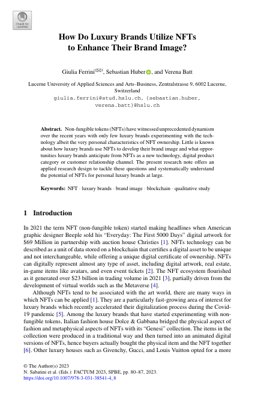
The meteoric rise of Non-Fungible Tokens (NFTs), exemplified by Beeple's $69 million sale at Christie's in 2021, has transcended the art world, presenting a paradigm shift for consumer-facing industries. Luxury brands, historically conservative yet image-centric, are now at a critical juncture. The COVID-19 pandemic accelerated digitalization, forcing brands to explore novel channels like NFTs. This research investigates the strategic utilization of NFTs by personal luxury brands (apparel, accessories, watches, etc.) to enhance their brand image—a core competitive asset in the luxury sector.
2. Research Methodology & Framework
This study proposes a qualitative research design to systematically explore the intersection of NFTs and luxury branding. The approach aims to move beyond technical analyses of blockchain protocols to understand managerial strategy and consumer perception.
2.1. Research Gap & Objectives
Despite the NFT market's explosive growth (over $23 billion in trading volume in 2021), academic research remains sparse, with a focus on technical standards rather than strategic brand applications. Luxury brands exhibit hesitation, creating a significant knowledge gap. The objective is to provide a concrete, systematic review of how NFTs are developed and deployed to shape brand image.
2.2. Core Research Questions
The research is guided by two pivotal questions:
- How are NFTs utilised to enhance different brand image factors of luxury brands?
- What opportunities do luxury brand managers associate with NFTs as a new technology, product category, or customer relationship channel?
Market Context
$23B+ NFT trading volume in 2021.
32 academic articles on NFTs (2017-2021).
Segments: Apparel, Accessories, Watches, Jewelry, Eyewear.
3. NFT Applications in Luxury Branding
Luxury brands are experimenting with NFTs along a spectrum from digital-physical hybrids to purely digital assets, each serving distinct brand-building purposes.
3.1. Case Studies: Dolce & Gabbana, Gucci, Louis Vuitton
Dolce & Gabbana's "Genesi" Collection: A pioneering hybrid model where buyers acquired both a physical garment and its animated NFT counterpart. This bridges tangible craftsmanship with digital exclusivity.
Gucci, Louis Vuitton, Givenchy: These houses have adopted a more traditional path, releasing NFTs based on graphic designs or short films featuring their collections, focusing on digital artistry and brand storytelling.
3.2. Brand Image Enhancement Mechanisms
NFTs can enhance brand image through several key mechanisms:
- Exclusivity & Scarcity: Programmable scarcity on the blockchain reinforces luxury's core tenet of limited availability.
- Innovation & Modernity: Adopting cutting-edge technology positions the brand as a forward-thinking leader.
- Community & Engagement: NFTs can unlock access to exclusive communities, events, or experiences, deepening brand loyalty.
- Storytelling & Heritage: Digital tokens can encapsulate a product's provenance, craftsmanship story, or brand history in an immutable format.
4. Strategic Opportunities & Managerial Perspectives
For luxury brand managers, NFTs represent a multifaceted opportunity beyond mere revenue:
- New Product Category: Digital collectibles and wearables for virtual environments (Metaverse).
- Enhanced Customer Relationship Management (CRM): NFTs as keys to unlock loyalty rewards, personalized content, and co-creation opportunities.
- Anti-Counterfeiting & Provenance: Immutable blockchain records to authenticate products and assure buyers.
- Democratizing Access: Lower-price-point digital items can attract younger, digitally-native consumers to the brand ecosystem.
5. Technical Foundations & Blockchain Mechanics
An NFT is a unique cryptographic token on a blockchain (typically Ethereum) representing ownership of a specific asset. Its uniqueness is enforced by smart contracts. The token's metadata, often pointing to a digital file stored on the InterPlanetary File System (IPFS), contains details about the asset.
Key Technical Concept - Token Uniqueness: While fungible tokens (like Bitcoin) are identical and interchangeable, each NFT has a unique identifier ($ID_{NFT}$) stored on-chain, making it non-fungible. This can be conceptually simplified as:
$\text{NFT}_{\text{Asset}} = \text{Hash}(ID_{NFT} \, || \, \text{Metadata} \, || \, \text{Owner Address})$
Where $||$ denotes concatenation, and the Hash function (e.g., SHA-256) ensures data integrity.
6. Analytical Framework & Conceptual Model
Framework: The NFT-Brand Image Matrix
To analyze brand strategies, we propose a 2x2 matrix evaluating NFT projects based on two axes:
- Tangibility: Purely Digital <--> Phygital (Physical-Digital Hybrid).
- Utility: Collectible/Art <--> Functional/Experiential (e.g., event access, product unlock).
Example Application: Dolce & Gabbana's "Genesi" falls in the Phygital-Functional quadrant (physical item + digital twin). A Gucci digital art NFT might be Purely Digital-Collectible. This framework helps categorize initiatives and assess their alignment with specific brand image goals (e.g., innovation vs. heritage).
7. Future Applications & Industry Outlook
The convergence of NFTs, the Metaverse, and AI will define the next frontier:
- Dynamic & Evolving NFTs: NFTs whose appearance or utility changes based on owner behavior, real-world events, or time, using oracles and AI.
- Fractional Ownership & Investment: Tokenizing high-value physical assets (e.g., a rare watch) to democratize investment.
- Sustainability-Linked Tokens: NFTs that verify and track a product's sustainable materials and ethical supply chain, appealing to conscious consumers.
- Interoperable Digital Identity: A user's NFT-based digital wardrobe or identity seamlessly moving across different virtual worlds and games.
8. Critical Analysis & Expert Commentary
Core Insight: This paper correctly identifies the central tension: luxury's inherent conservatism versus the disruptive, democratizing potential of Web3. The real story isn't about selling JPEGs; it's about luxury brands attempting to control the narrative of ownership, exclusivity, and community in a digital-first future. They're not just adopting a technology; they're fighting to redefine luxury's codes for Gen Z and Alpha.
Logical Flow: The research structure is sound—from establishing the market phenomenon (NFT boom) to pinpointing the academic gap, then proposing a qualitative method to explore managerial strategy. It wisely focuses on "brand image," the lifeblood of luxury, rather than getting bogged down in speculative finance or pure tech.
Strengths & Flaws: Its strength is its applied, managerial focus. However, the proposed methodology feels tentative. A robust analysis would require not just interviewing brand managers (who may offer PR-sanitized views) but also analyzing on-chain data, social sentiment around NFT drops, and conducting consumer surveys. The paper nods to the "personal" nature of NFT ownership but under-explores the community dynamics and secondary market speculation, which can drastically alter brand perception (e.g., price crashes causing brand dilution). It also glosses over significant hurdles: the massive environmental stigma of proof-of-work blockchains (despite Ethereum's move to proof-of-stake), regulatory uncertainty, and the risk of attracting purely speculative "flippers" rather than genuine brand advocates.
Actionable Insights: For luxury executives, the takeaway is twofold. First, experiment with purpose. Don't launch an NFT as a gimmick; use it to solve a real brand challenge—provenance, community engagement, or storytelling. Start in the Phygital-Functional quadrant to bridge the trust gap for traditional clients. Second, prepare for ecosystem play. The endgame isn't standalone NFT drops, but building a token-gated brand universe. Look at Nike's .Swoosh platform or Adidas's Into the Metaverse as benchmarks. Partner with established Web3 platforms to mitigate technical risk. Finally, develop a clear narrative on sustainability and value—beyond mere digital scarcity—to avoid backlash. The brands that will win are those that use NFTs not as a product line, but as a foundational layer for a new, participatory brand relationship.
9. References
- Christie's. (2021). Beeple's "Everydays: The First 5000 Days" Auction.
- Wang, Q., Li, R., Wang, Q., & Chen, S. (2021). Non-Fungible Token (NFT): Overview, Evaluation, Opportunities and Challenges. arXiv preprint arXiv:2105.07447.
- DappRadar. (2022). 2021 NFT Market Report.
- Mystakidis, S. (2022). Metaverse. Encyclopedia, 2(1), 486-497.
- Deloitte. (2022). Global Powers of Luxury Goods 2022.
- Dolce & Gabbana. (2021). Genesi Collection. [Press Release].
- Bain & Company. (2022). Luxury Goods Worldwide Market Study, Fall-Winter 2022.
- Kapferer, J. N., & Bastien, V. (2012). The Luxury Strategy: Break the Rules of Marketing to Build Luxury Brands. Kogan Page.
- Ante, L. (2022). Non-fungible token (NFT) markets on the Ethereum blockchain: Temporal development, cointegration and interrelations. Economics of Innovation and New Technology.
- Chalmers, D., Fisch, C., Matthews, R., Quinn, W., & Recker, J. (2022). Beyond the bubble: Will NFTs and digital proof of ownership empower creative industry entrepreneurs? Journal of Business Venturing Insights, 17, e00309.
- Keller, K. L. (1993). Conceptualizing, measuring, and managing customer-based brand equity. Journal of Marketing, 57(1), 1-22.
- Vigneron, F., & Johnson, L. W. (2004). Measuring perceptions of brand luxury. Journal of Brand Management, 11(6), 484-506.
- Park, H., & Kim, Y. K. (2020). The role of social network websites in the consumer-brand relationship. Journal of Retailing and Consumer Services, 54, 102052.
- Ismail, L. (2022). Luxury Fashion Brands' Strategies in the Metaverse. In Fashion and Environmental Sustainability (pp. 175-192). Springer.
- Dubois, B., Laurent, G., & Czellar, S. (2001). Consumer rapport to luxury: Analyzing complex and ambivalent attitudes. Les Cahiers de Recherche, 736, 1-56.
- Ferreira, J. J., Fernandes, C. I., & Ferreira, F. A. (2020). What makes a brand cool? A conceptual model. Journal of Business Research, 118, 443-454.