Table of Contents
1. Introduction
Emerging technologies in HCI, particularly digital fabrication (e.g., 3D printing, laser cutting), have democratized design and prototyping. However, this accessibility comes with a significant environmental cost. The prototyping process is inherently iterative and often wasteful, consuming energy and a wide variety of materials, especially plastics. Improper disposal leads to microplastic pollution, with an estimated 11–23 million tons of plastic entering oceans annually [4]. This paper introduces "THE WASTIVE," an interactive art installation that confronts this issue by transforming digital fabrication waste from a passive byproduct into an active, observing entity.
2. The Wastive: Concept & Artistic Vision
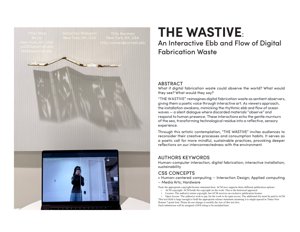
"THE WASTIVE" poses a poetic question: What if digital fabrication waste could observe the world? What would they see? What would they say? The installation reimagines discarded materials—failed 3D prints, support structures, laser-cut scraps—as sentient observers. It creates a silent dialogue where this technological residue "observes" and responds to human presence. The core interaction mimics the rhythmic ebb and flow of ocean waves, evoking the gentle murmurs of the sea and directly linking the waste to its potential environmental endpoint. This transforms a typically ignored material flow into a reflective, sensory experience aimed at provoking deeper consideration of our creative and consumption habits.
Key Insight
The project shifts the perspective from humans observing waste to being observed by waste, creating a powerful reflexive loop that challenges viewer complacency.
3. Technical Implementation & Interaction Design
The installation likely employs a sensor-actuator system. As viewers approach, proximity sensors (e.g., ultrasonic or infrared) detect presence. This input triggers actuated components within the assemblage of waste materials, causing them to move in a wave-like pattern. The choice of wave motion is critical, serving as both a universal natural rhythm and a direct metaphor for the oceanic fate of much plastic pollution. The technical goal is to create a seamless, poetic feedback loop: human approach → sensor detection → algorithmic wave generation → actuator movement → visual/auditory response.
3.1. Mathematical Model for Wave Motion
The ebb and flow can be modeled using a damped sinusoidal wave function to simulate natural, calming motion. The position $P_i(t)$ of each actuator $i$ at time $t$ could be governed by:
$P_i(t) = A \cdot \sin(2\pi f t + \phi_i) \cdot e^{-\lambda t} + B$
Where:
- $A$ is the amplitude (maximum movement).
- $f$ is the frequency of the wave.
- $\phi_i$ is the phase offset for actuator $i$, creating a wave propagation effect.
- $\lambda$ is the damping coefficient, causing the motion to gradually settle.
- $B$ is the baseline position.
3.2. Analysis Framework: The Observation Loop
Case Example (Non-Code): To deconstruct the installation's impact, we can apply a simple framework analyzing the "Observation Loop":
- Subject/Object Inversion: The waste (traditionally object) becomes the observing subject. The human (traditionally subject) becomes the observed object.
- Sensory Translation: Abstract environmental impact (tons of plastic) is translated into an immediate, localized sensory experience (wave motion, sound).
- Metaphorical Bridge: The wave mechanic builds a direct metaphorical bridge between the act of fabrication (source) and oceanic pollution (endpoint).
- Behavioral Nudge: The reflexive experience aims not to prescribe action but to create cognitive dissonance that may nudge future behavior.
4. Related Work & Context
THE WASTIVE situates itself within Sustainable Interaction Design (SID) [1, 2], which seeks to integrate environmental considerations into computing. It responds to calls for more sustainable prototyping lifecycles in digital fabrication [3]. While prior work focuses on technical solutions like eco-friendly materials (e.g., filaments from spent coffee grounds [5, 6]), THE WASTIVE addresses the perceptual and behavioral gap. It operates in the tradition of critical design and speculative art in HCI, using poetic interaction to foster emotional and reflective engagement with sustainability issues, reaching beyond expert communities.
5. Analysis & Critical Interpretation
Core Insight: THE WASTIVE is not a waste management solution; it's a sophisticated perceptual hack. Its real innovation lies in using HCI's core strength—creating engaging user experiences—to reframe an environmental externality as an intimate, observable interaction. It makes the abstract consequence of microplastic pollution personally tangible.
Logical Flow: The project's logic is elegantly circular: Digital fabrication creates waste → waste pollutes oceans → the installation uses wave motion (ocean metaphor) to give waste agency → this agency makes the pollution feedback loop feel immediate to the viewer → potentially influencing future fabrication decisions. It closes a cognitive gap in the cause-effect chain.
Strengths & Flaws: Its strength is its potent, simple metaphor and high-impact experiential learning. It avoids being didactic. However, its flaw is inherent to art-based interventions: measurability. Does a reflective experience in a gallery translate to reduced waste in a maker lab? The project would be strengthened by a mixed-methods study pairing the installation with tracking of participants' subsequent prototyping behavior, similar to how research on nudges is validated.
Actionable Insights: For HCI researchers and practitioners, THE WASTIVE demonstrates the untapped potential of "embodied environmental feedback." Instead of just displaying a carbon footprint dashboard, future sustainable systems could embody their impact in their interaction modality—a printer that physically resists or slows down when using virgin plastic, or a design tool whose interface glitches metaphorically as material waste increases. The insight is to bake sustainability into the feel of the interaction, not just the output.
6. Future Directions & Applications
The concept of "sentient waste" has broad applications:
- Educational Tools: Scalable versions for maker spaces, fab labs, and schools, where the installation provides real-time, ambient feedback on waste generation.
- Design Software Plugins: Integrating a "waste awareness" module into CAD/CAM software that visualizes or sonifies estimated waste during the design phase.
- Industrial Contexts: Adapting the observational metaphor for factory floors, where large-scale fabrication waste streams are monitored and represented through data physicalization.
- Extended Reality (XR): Using AR to overlay digital "waste observers" on physical prototypes, creating a persistent layer of environmental feedback throughout the design process.
7. References
- Blevis, E. (2007). Sustainable interaction design: invention & disposal, renewal & reuse. Proceedings of the SIGCHI Conference on Human Factors in Computing Systems (CHI '07).
- DiSalvo, C., Sengers, P., & Brynjarsdóttir, H. (2010). Mapping the landscape of sustainable HCI. Proceedings of the SIGCHI Conference on Human Factors in Computing Systems (CHI '10).
- Eldy, et al. (2023). A Sustainable Prototyping Life Cycle for Digital Fabrication. Proceedings of the ACM on Human-Computer Interaction.
- IUCN. (2021). Marine plastics. International Union for Conservation of Nature.
- Rivera, M. L., et al. (2022). Sustainable 3D Printing Filament from Spent Coffee Grounds. ACS Sustainable Chemistry & Engineering.
- Zhu, J., et al. (2021). Development of Biodegradable Composites for Fused Filament Fabrication. Additive Manufacturing.
- Isola, P., Zhu, J., Zhou, T., & Efros, A. A. (2017). Image-to-Image Translation with Conditional Adversarial Networks. Proceedings of the IEEE Conference on Computer Vision and Pattern Recognition (CVPR). (Cited as an example of a transformative technical approach in a different domain).
- Ellen MacArthur Foundation. (2022). The Global Commitment 2022 Progress Report. (Cited for authoritative data on circular economy principles).