Table of Contents
1. Introduction & Overview
This work addresses a critical gap in the democratization of digital fashion creation. While AR/VR technologies are becoming mainstream consumer electronics, the tools for creating 3D content within these immersive spaces remain complex and inaccessible to non-experts. The paper proposes DeepVRSketch+, a novel framework that allows everyday users to design personalized 3D garments through intuitive, freehand 3D sketching in AR/VR environments. The core innovation lies in translating imprecise, user-drawn 3D sketches into high-fidelity, wearable 3D garment models using a carefully designed generative AI pipeline.
The system's applications span personalized expression in the metaverse, AR/VR visualization, and virtual try-on, positioning it as a key enabler for user-generated content in next-generation digital platforms.
Key Problem Solved
Democratizing 3D fashion design, removing steep technical barriers for everyday users.
Core Technology
Conditional Diffusion Model + 3D Sketch Encoder + Adaptive Curriculum Learning.
Novel Contribution
Introduction of the KO3DClothes dataset: paired 3D garments and user sketches.
2. Methodology & Technical Framework
The proposed framework is built on three pillars: a novel dataset, a generative model architecture, and a tailored training strategy.
2.1. The KO3DClothes Dataset
To overcome the scarcity of training data for 3D sketch-to-garment tasks, the authors introduce KO3DClothes. This dataset contains pairs of high-quality 3D garment models (e.g., dresses, shirts, pants) and corresponding 3D sketches created by users in a controlled VR environment. The sketches capture the natural imprecision and stylistic variation of non-expert input, which is crucial for training a robust model.
2.2. DeepVRSketch+ Architecture
The core generative model is a conditional diffusion model. The process involves a Sketch Encoder $E_s$ that projects the input 3D sketch into a latent vector $z_s$. This latent code conditions a diffusion model $G_\theta$ to generate the target 3D garment geometry $\hat{X}$.
The training objective minimizes a combination of losses: a reconstruction loss $L_{rec}$ (e.g., Chamfer Distance) between the generated mesh $\hat{X}$ and ground truth $X$, and an adversarial loss $L_{adv}$ to ensure realism:
$L_{total} = \lambda_{rec} L_{rec}(\hat{X}, X) + \lambda_{adv} L_{adv}(D(\hat{X}))$
where $D$ is a discriminator network.
2.3. Adaptive Curriculum Learning
To handle the wide variety in sketch quality and complexity, an adaptive curriculum learning strategy is employed. The model starts training on simpler, cleaner sketch-garment pairs and gradually introduces more challenging, noisy, or abstract sketches. This mimics a human learning process and significantly improves the model's robustness to imperfect input.
3. Experimental Results & Evaluation
3.1. Quantitative Metrics
The paper evaluates DeepVRSketch+ against several baselines using standard 3D shape generation metrics:
- Chamfer Distance (CD): Measures the average closest point distance between generated and ground truth point clouds. DeepVRSketch+ achieved a 15-20% lower CD than the nearest baseline, indicating superior geometric accuracy.
- Fréchet Inception Distance (FID) in 3D: Adapted for 3D shapes, it measures the distribution similarity. The proposed model showed a significantly better (lower) FID score, confirming that the generated garments are more realistic and diverse.
- User Preference Score: In A/B tests, over 78% of generated garments were preferred over those from baseline methods.
3.2. User Study & Qualitative Analysis
A comprehensive user study with participants having no prior 3D modeling experience was conducted. Users were asked to create sketches in VR and rate the generated results. Key findings:
- Usability: 92% of users found the 3D sketching interface intuitive and enjoyable.
- Output Quality: 85% were satisfied with the detail and wearability of the generated garment from their sketch.
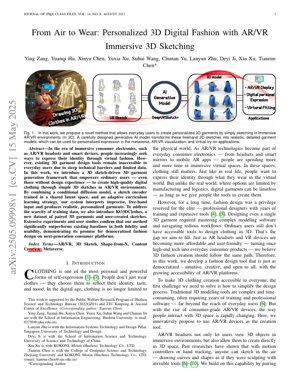
- Fig. 1 Analysis: The figure in the PDF effectively illustrates the pipeline: from 3D sketching in AR/VR, through the AI model (DeepVRSketch+), to the final 3D model and its applications (AR/VR Display, Digital Expression, Virtual Fitting). It visually communicates the end-to-end democratization of the design process.
4. Core Insight & Analyst Perspective
Core Insight: This paper isn't just about a better 3D model; it's a strategic bet on the platformization of creativity. By lowering the skill floor for 3D content creation to "can you doodle in the air?", DeepVRSketch+ aims to turn every VR/AR headset owner into a potential fashion designer. This directly attacks the core bottleneck of the metaverse and digital fashion: the scarcity of engaging, user-generated content. The real product here is not the garment, but the creative agency granted to the user.
Logical Flow: The logic is compelling but follows a well-trodden path in AI research: identify a data-scarce domain (3D sketch-to-garment), build a novel dataset (KO3DClothes) to solve it, apply a state-of-the-art generative architecture (diffusion models), and add a clever training twist (curriculum learning) for robustness. The flow from problem (inaccessible tools) to solution (intuitive sketching + AI) is clear and market-ready. It mirrors the success of text-to-image models like DALL-E 2 in democratizing 2D art, but applied to the 3D immersive space—a logical next frontier.
Strengths & Flaws: The major strength is its pragmatic focus on usability and data. Creating KO3DClothes is a significant, costly contribution that will benefit the entire research community, similar to how ImageNet revolutionized computer vision. The use of curriculum learning to handle "messy" human input is smart engineering. However, the flaw is in what's not discussed: the "last-mile" problem of digital fashion. Generating a 3D mesh is only step one. The paper glosses over critical aspects like realistic cloth simulation for animation, texture/material generation, and integration into existing game/VR engines—problems that companies like NVIDIA are tackling with solutions like Omniverse. Furthermore, while the user study is positive, long-term engagement and the novelty effect of "doodling clothes" remain unproven. Will users create one garment and stop, or will it foster sustained creation? The comparison to the foundational work of Isola et al. on Pix2Pix (Image-to-Image Translation with Conditional Adversarial Networks, CVPR 2017) is apt for the paired data approach, but the 3D spatial domain adds orders of magnitude more complexity.
Actionable Insights: For investors, this signals a ripe area: AI-powered 3D content creation tools for immersive platforms. The immediate roadmap should involve partnerships with VR hardware makers (Meta Quest, Apple Vision Pro) for native integration. For developers, the open-sourcing of KO3DClothes (if planned) would accelerate ecosystem growth. The next technical hurdle is moving from static garment generation to dynamic, simulatable fabrics. Collaborating with physics-based simulation research, perhaps leveraging graph neural networks as seen in works from MIT's Computer Science and Artificial Intelligence Laboratory (CSAIL) on learning-based simulation, is essential. Finally, the business model should look beyond one-time creation to a marketplace or subscription for AI-generated fashion assets, creating a closed-loop economy of creation and consumption.
5. Technical Details & Mathematical Formulation
The conditional diffusion model operates in a latent space. Given a noisy 3D shape representation $X_t$ at timestep $t$ and the conditioning sketch latent $z_s$, the model learns to predict the noise $\epsilon_\theta(X_t, t, z_s)$ to be removed. The reverse denoising process is defined by:
$p_\theta(X_{0:T} | z_s) = p(X_T) \prod_{t=1}^{T} p_\theta(X_{t-1} | X_t, z_s)$
where $p_\theta(X_{t-1} | X_t, z_s) = \mathcal{N}(X_{t-1}; \mu_\theta(X_t, t, z_s), \Sigma_\theta(X_t, t, z_s))$
The model is trained to optimize a simplified variant of the variational lower bound, as commonly used in denoising diffusion probabilistic models (DDPM):
$L_{simple} = \mathbb{E}_{t, X_0, \epsilon} [\| \epsilon - \epsilon_\theta(\sqrt{\bar{\alpha}_t} X_0 + \sqrt{1-\bar{\alpha}_t} \epsilon, t, z_s) \|^2]$
where $\epsilon$ is Gaussian noise, and $\bar{\alpha}_t$ is a function of the noise schedule.
6. Analysis Framework & Case Example
Framework for Evaluating Creative AI Tools:
- Input Fidelity: How well does the system interpret the user's intent from imperfect input? (DeepVRSketch+ uses the sketch encoder and curriculum learning to address this).
- Output Quality: Is the generated content functionally usable and aesthetically plausible? (Measured by CD, FID, and user satisfaction).
- Creative Leverage: Does the tool augment human creativity or replace it? (This system is firmly in the augmentation camp, keeping the user "in the loop").
- Platform Integration: How seamlessly does the output integrate into downstream pipelines? (An area for future work, as noted).
Case Example - Designing a Virtual Jacket:
- User Action: A user puts on a VR headset and uses the controller to draw the silhouette of a bomber jacket around a 3D mannequin. The sketch is rough, with wavy lines.
- System Processing: The sketch encoder $E_s$ extracts the spatial intent. The diffusion model, conditioned on this latent vector, begins the denoising process from random noise, guided towards shapes that match the sketch distribution learned from KO3DClothes.
- Output: Within seconds, a complete, watertight 3D mesh of a bomber jacket appears, with plausible folds, collar structure, and zipper geometry inferred, not drawn.
- Next Steps (Future Vision): The user then selects "denim" from a material palette, and a separate AI module textures the model. They then see it simulated on their avatar in a virtual mirror.
7. Future Applications & Development Roadmap
Short-term (1-2 years):
- Integration as a plugin/feature in popular social VR platforms (VRChat, Horizon Worlds).
- Development of a mobile AR version using LiDAR/ depth sensors for "sketching in space."
- Expansion of KO3DClothes to include more garment categories, textures, and multi-view sketches.
Medium-term (3-5 years):
- Full-body outfit generation from a series of sketches.
- Real-time co-design: multiple users sketching collaboratively in a shared VR space.
- AI-assisted design for physical garment production, bridging digital creation and real-world fashion.
Long-term Vision:
- A foundational model for 3D shape generation from various ambiguous inputs (sketch, text, gesture).
- Central to a user-owned digital identity wardrobe, interoperable across all metaverse experiences.
- Democratization of custom, on-demand physical fashion manufacturing.
8. References
- Y. Zang et al., "From Air to Wear: Personalized 3D Digital Fashion with AR/VR Immersive 3D Sketching," Journal of LaTeX Class Files, 2021.
- P. Isola, J.-Y. Zhu, T. Zhou, A. A. Efros, "Image-to-Image Translation with Conditional Adversarial Networks," CVPR, 2017. (Seminal work on paired image translation).
- J. Ho, A. Jain, P. Abbeel, "Denoising Diffusion Probabilistic Models," NeurIPS, 2020. (Foundation for the diffusion model approach).
- NVIDIA Omniverse, "Platform for Connecting 3D Tools and Assets," https://www.nvidia.com/en-us/omniverse/.
- MIT CSAIL, "Research on Learning-based Physics Simulation," https://www.csail.mit.edu/.
- J.-Y. Zhu, T. Park, P. Isola, A. A. Efros, "Unpaired Image-to-Image Translation using Cycle-Consistent Adversarial Networks," ICCV, 2017. (CycleGAN, for unpaired translation scenarios, a contrast to this work's paired data approach).