Table of Contents
1. Introduction & Overview
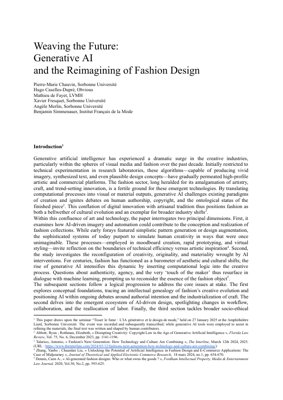
Generative Artificial Intelligence (AI) has catalyzed a paradigm shift within the creative industries, with fashion design emerging as a particularly fertile and contested ground. This paper, stemming from the seminar "Tisser le futur," interrogates the dual impact of AI: its role in augmenting the conception and realization of fashion collections, and its profound reconfiguration of core concepts like creativity, originality, and materiality. The transition from technical experimentation to commercial and artistic application challenges centuries-old traditions, positioning fashion as a bellwether for broader cultural and industrial evolution in the age of computational creativity.
2. Conceptual Foundations
2.1 Intellectual Genealogy of Fashion Creativity
Fashion has long been a dialectic between artisan craft and industrial innovation. The introduction of generative AI represents the latest chapter in this evolution, inserting computational logic directly into the creative ideation phase. This challenges the romantic notion of the solitary genius designer, suggesting a more collaborative, iterative, and data-informed model of creation.
2.2 AI, Authorial Intention & the Industrialization of Craft
The paper positions AI within ongoing debates about authorship. When a design is co-created with an algorithm trained on millions of existing images, where does authorial intention reside? This questions the ontological status of the fashion object itself, blurring the lines between human inspiration and machine execution, and potentially further industrializing the craft of design.
3. The AI-Driven Design Ecosystem
3.1 Workflow Transformation: From Moodboard to Prototype
AI tools are being integrated across the design pipeline. In the initial phase, systems like Midjourney or Stable Diffusion can generate vast arrays of visual concepts and moodboards based on textual prompts, dramatically accelerating ideation. For prototyping, AI can suggest pattern variations, generate textile prints, or create 3D garment simulations, reducing the time and cost of physical sampling.
3.2 Reconfiguring Collaboration and Labor
The integration of AI necessitates new workflows and skill sets. The designer's role may evolve from primary creator to "creative director" or "prompt engineer," curating and refining AI-generated outputs. This could lead to a reallocation of labor, potentially automating certain repetitive tasks while elevating the importance of critical editing, aesthetic judgment, and strategic vision.
4. Socio-Ethical & Legal Ramifications
4.1 Ownership, Copyright, and Authenticity
Legal frameworks struggle to accommodate AI-generated content. Key questions include: Who owns the copyright to an AI-assisted design—the prompt writer, the model developer, or no one? Does training on copyrighted fashion imagery constitute infringement? These disputes, as noted in legal scholarship, challenge the very foundations of intellectual property law in creative fields.
4.2 Environmental Impact & Data-Driven Aesthetics
The environmental cost of training and running large generative models is significant, contradicting fashion's growing sustainability agenda. Furthermore, AI models trained on historical data may perpetuate or amplify existing aesthetic biases, leading to homogenized, data-driven trends that lack cultural diversity or subversive edge.
5. Technical Deep Dive & Analysis
Core Insight
The paper's core insight is that generative AI is not merely a new tool, but a disruptive agent redefining the ontology of fashion creation. It moves design from a materially-grounded, human-centric craft to a computationally-mediated, prompt-driven process. The real tension isn't human vs. machine, but between efficiency-driven automation and meaning-driven authorship.
Logical Flow
The argument progresses logically from phenomenon (AI's rise in fashion) to mechanism (how it changes workflow and collaboration) to implication (socio-ethical fallout). However, it leans heavily on conceptual and ethical discourse, offering less on the specific technical architectures (e.g., GANs, Diffusion Models, Transformers) that power these changes. A deeper dive into models like StyleGAN or the latent space manipulations central to tools like DALL-E 3 would strengthen the technical critique.
Strengths & Flaws
Strengths: Excellently frames the macro ethical and philosophical dilemmas. The connection to historical debates on industrialization and authorship is sharp. The reference to projects like "The Next Rembrandt" effectively bridges art and fashion contexts.
Critical Flaws: It is notably light on quantitative analysis. Where are the case studies measuring time-to-market reduction, cost savings, or consumer reception of AI-generated vs. human-designed collections? The environmental critique is mentioned but not substantiated with data on compute costs (e.g., the energy consumption of training a model like Stable Diffusion, estimated by researchers at Hugging Face and others to be substantial). It risks being a theoretical treatise disconnected from the hard metrics of business impact.
Actionable Insights
For industry leaders:
1. Invest in "Hybrid Intelligence" Workflows: Don't replace designers, but build teams where AI handles high-volume, low-variance ideation and prototyping, freeing humans for high-context editing, storytelling, and material innovation.
2. Audit Your Data and Models: Proactively address bias and IP risk. Curate diverse, ethically-sourced training datasets and explore federated learning or synthetic data to mitigate copyright exposure.
3. Develop New IP and Governance Frameworks: Lobby for and adopt clear internal policies on AI-generated design ownership. Consider blockchain or other provenance tech to track the human-AI contribution chain.
4. Measure the Real ROI: Move beyond hype. Pilot projects must track not just creativity metrics, but also sustainability impact (compute vs. material waste), speed, cost, and market performance.
Original Analysis & Technical Details
The transformative potential of generative AI in fashion hinges on its underlying mathematical frameworks. At its core, a model like a Generative Adversarial Network (GAN), as introduced by Goodfellow et al. (2014), operates on a game-theoretic principle. A generator network $G$ learns to map random noise $z$ from a prior distribution $p_z(z)$ to data space ($G(z)$), attempting to produce realistic samples. Simultaneously, a discriminator network $D$ estimates the probability that a sample came from the real training data rather than $G$. The two networks are trained in opposition: $G$ aims to minimize $\log(1 - D(G(z)))$ while $D$ aims to maximize $\log D(x) + \log(1 - D(G(z)))$, where $x$ is real data. This adversarial process can be formalized as a minimax game with value function $V(D,G)$: $$\min_G \max_D V(D, G) = \mathbb{E}_{x\sim p_{data}(x)}[\log D(x)] + \mathbb{E}_{z\sim p_z(z)}[\log(1 - D(G(z)))]$$ In fashion, $p_{data}(x)$ represents the distribution of all existing garment images, textures, and sketches. The generator learns this manifold, allowing it to produce novel yet coherent designs. More recent diffusion models, like those powering Stable Diffusion, work by progressively adding noise to data and then learning to reverse this process, offering finer control and higher-quality outputs. Research from institutions like MIT's Media Lab has demonstrated how these models can be conditioned on specific attributes (e.g., "silk," "Victorian," "deconstructed"), enabling targeted exploration of design spaces.
Experiments & Chart Description
While the PDF references the seminal "The Next Rembrandt" project, analogous experiments in fashion are emerging. A hypothetical but representative experiment could involve training a StyleGAN2 model on a dataset of 50,000 haute couture evening gown images from the 20th and 21st centuries. The output would be a latent space where vector arithmetic can be performed. For example, moving a vector in the direction of ["Balenciaga"] + ["futuristic"] - ["1950s"] would generate novel gown designs blending those attributes. A key chart for analysis would be a t-SNE (t-Distributed Stochastic Neighbor Embedding) plot visualizing this high-dimensional latent space. Clusters would emerge corresponding to distinct styles (e.g., Romantic, Minimalist, Avant-Garde), and the density of points would reveal areas of over-explored design tropes versus "blank spaces" ripe for innovation. The distance between a human designer's sketch and the nearest AI-generated cluster could be a metric of its perceived novelty or derivativeness.
Analysis Framework Example (Non-Code)
Framework: The "Creative Fidelity vs. Novelty" Matrix
This framework evaluates AI's role in a design project on two axes:
1. Creative Fidelity: How closely must the output adhere to a specific brand DNA, historical reference, or technical constraint? (Low to High).
2. Novelty Seeking: Is the goal to explore radically new forms, silhouettes, or combinations? (Low to High).
Quadrant Application:
- High Fidelity, Low Novelty (e.g., seasonal colorway variations): Ideal for AI automation. Use a tightly constrained model.
- High Fidelity, High Novelty (e.g., a heritage brand's futuristic capsule): Requires intense human-AI collaboration. AI generates wild concepts, humans curate for brand alignment.
- Low Fidelity, High Novelty (e.g., conceptual art-fashion): AI can be used as a pure inspiration engine, with humans providing the final creative interpretation and material realization.
- Low Fidelity, Low Novelty (e.g., basic garment templates): Perhaps not worth significant AI investment.
6. Future Applications & Directions
The trajectory points beyond 2D image generation. The future lies in 3D generative models that output directly to digital twin avatars and CAD files for manufacturing, closing the loop from ideation to production. Multimodal AI will accept not just text but sketches, fabric swatches, and mood music as input. A major frontier is physical material generation—AI suggesting novel biomaterials or weave structures with desired properties (strength, drape, sustainability). Furthermore, personalized co-creation will become mainstream, where consumers use AI tools to customize designs in real-time, challenging the traditional seasonal collection model. However, this future depends on resolving the critical path dependencies identified in this paper: establishing clear legal ownership, mitigating environmental costs, and ensuring these tools augment rather than homogenize human creativity.
7. References
- Abbott, R., & Rothman, E. (2023). Disrupting Creativity: Copyright Law in the Age of Generative Artificial Intelligence. Florida Law Review, 75(6), 1141-1196.
- Dennis, C. A. (2020). AI-generated fashion designs: Who or what owns the goods? Fordham Intellectual Property, Media & Entertainment Law Journal, 30(2), 593-625.
- Goodfellow, I., Pouget-Abadie, J., Mirza, M., Xu, B., Warde-Farley, D., Ozair, S., Courville, A., & Bengio, Y. (2014). Generative Adversarial Nets. Advances in Neural Information Processing Systems, 27.
- Ho, J., Jain, A., & Abbeel, P. (2020). Denoising Diffusion Probabilistic Models. Advances in Neural Information Processing Systems, 33, 6840-6851.
- Karras, T., Laine, S., Aittala, M., Hellsten, J., Lehtinen, J., & Aila, T. (2020). Analyzing and Improving the Image Quality of StyleGAN. Proceedings of the IEEE/CVF Conference on Computer Vision and Pattern Recognition (CVPR).
- Zhang, Y., & Liu, C. (2024). Unlocking the Potential of Artificial Intelligence in Fashion Design and E-Commerce Applications: The Case of Midjourney. Journal of Theoretical and Applied Electronic Commerce Research, 19(1), 654-670.
- MIT Media Lab, Computational Fashion Research. https://www.media.mit.edu/groups/computational-fashion/overview/
- Hugging Face. (2023). The Environmental Impact of Deep Learning. [Blog Post].