1. Introduction
With the rapid growth of the online fashion market, there is a critical need for effective recommendation systems. Traditional collaborative filtering methods, which rely on user purchase history (ratings), are ill-suited for fashion. A user's history may contain disparate styles (e.g., formal suits and casual denim), making it impossible to learn coherent, fine-grained style features for individual items or outfits. The core challenge is to model the subtle, often subjective notion of "style compatibility" between items.
This paper introduces Style2Vec, a novel distributed representation model for fashion items. Inspired by distributional semantics in NLP (e.g., Word2Vec), it learns item embeddings from user-curated "style sets"—collections of garments and accessories that form a cohesive outfit. The key innovation is using Convolutional Neural Networks (CNNs) as projection functions from item images to embedding vectors, overcoming the sparsity issue where individual items appear in few style sets.
2. Methodology
2.1. Problem Formulation & Style Sets
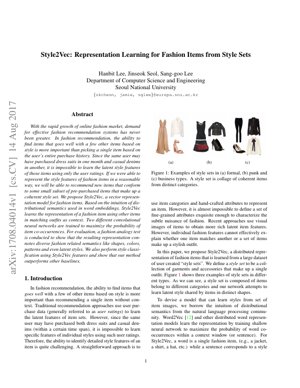
A style set is defined as a collection of items (e.g., jacket, shirt, pants, shoes, bag) that together constitute a single, coherent outfit. It is analogous to a "sentence" in NLP, while each individual fashion item is a "word." The model's objective is to learn a function $f: I \rightarrow \mathbb{R}^d$ that maps an item image $I$ to a $d$-dimensional latent style vector, such that items belonging to the same style set have similar vectors in the embedding space.
2.2. Style2Vec Architecture
The model employs two separate Convolutional Neural Networks (CNNs):
- Input CNN ($\text{CNN}_i$): Processes the image of the target item whose representation is being learned.
- Context CNN ($\text{CNN}_c$): Processes the images of the context items (other items in the same style set).
Both networks map their respective input images to the same $d$-dimensional embedding space. This dual-network approach allows the model to differentiate between the role of the target item and its context during learning.
2.3. Training Objective
The model is trained using a contrastive learning objective inspired by skip-gram with negative sampling. For a given style set $S = \{i_1, i_2, ..., i_n\}$, the goal is to maximize the probability of observing any context item $i_c$ given a target item $i_t$. The objective function for a single (target, context) pair is:
$$ J(\theta) = \log \sigma(\mathbf{v}_{i_t} \cdot \mathbf{v}_{i_c}) + \sum_{k=1}^{K} \mathbb{E}_{i_k \sim P_n} [\log \sigma(-\mathbf{v}_{i_t} \cdot \mathbf{v}_{i_k})] $$
where $\mathbf{v}_{i} = \text{CNN}(I_i)$ is the embedding of item $i$, $\sigma$ is the sigmoid function, and $P_n$ is a noise distribution for negative sampling of $K$ negative examples.
3. Experimental Setup
3.1. Dataset
The model was trained on 297,083 user-created style sets collected from a popular fashion website. Each set contains multiple item images from distinct categories (tops, bottoms, shoes, accessories).
Dataset Statistics
Total Style Sets: 297,083
Avg. Items per Set: ~5-7
Item Categories: Diverse (clothing, footwear, accessories)
3.2. Baseline Models
Performance was compared against several baselines:
- Category-based: Using one-hot encoded item categories as features.
- Attribute-based: Using hand-crafted visual attributes (color, pattern).
- CNN Features: Using pre-trained CNN (e.g., ResNet) features from individual item images, ignoring set context.
- Traditional Word2Vec on Categories: Treating item categories as "words" in style set "sentences."
3.3. Evaluation Metrics
Two primary evaluation methods were used:
- Fashion Analogy Test: Analogous to the "king - man + woman = queen" test in word embeddings. Evaluates if learned vectors capture semantic relationships (e.g., "ankle boot - winter + summer = sandal").
- Style Classification: Using the learned Style2Vec features as input to a classifier to predict pre-defined style labels (e.g., formal, punk, business casual). Accuracy is used as the metric.
4. Results & Analysis
4.1. Fashion Analogy Test
Style2Vec successfully solved a variety of fashion analogies, demonstrating that its embeddings capture rich semantics beyond basic categories. Examples include transformations related to:
- Seasonality: Winter item → Summer item.
- Formality: Casual item → Formal item.
- Color/Pattern: Solid color item → Patterned item.
- Silhouette/Shape: Fitted item → Loose item.
This indicates the model learned a disentangled representation where specific dimensions or directions in the vector space correspond to interpretable style attributes.
4.2. Style Classification Performance
When used as features for a style classifier, Style2Vec embeddings significantly outperformed all baseline methods. The key insight is that features learned from co-occurrence in style sets are more predictive of overarching style labels than features from individual images (CNN baselines) or metadata (category/attribute baselines). This validates the core hypothesis that style is a relational property best learned from context.
Key Insights
- Context is King: Style is not an intrinsic property of an item but emerges from its relationship with other items.
- Overcoming Sparsity: Using CNNs as trainable projection networks effectively mitigates the data sparsity problem inherent in treating each unique item as a discrete token.
- Rich Semantics: The embedding space organizes items along multiple interpretable style dimensions, enabling complex analogical reasoning.
5. Technical Details & Mathematical Formulation
The core innovation lies in adapting the Word2Vec framework for the visual domain. Let $D = \{S_1, S_2, ..., S_N\}$ be the corpus of style sets. For a style set $S = \{I_1, I_2, ..., I_m\}$, where $I_j$ is an image, we sample a target item $I_t$ and a context item $I_c$ from $S$.
The embeddings are computed as: $$\mathbf{v}_t = \text{CNN}_i(I_t; \theta_i), \quad \mathbf{v}_c = \text{CNN}_c(I_c; \theta_c)$$ where $\theta_i$ and $\theta_c$ are the parameters of the input and context CNNs, respectively. The networks are trained end-to-end by optimizing the objective function $J(\theta)$ defined in Section 2.3 across all (target, context) pairs in the dataset. After training, only the Input CNN ($\text{CNN}_i$) is used to generate the final Style2Vec embedding for any new item image.
6. Analysis Framework: A Non-Code Case Study
Scenario: A fashion e-commerce platform wants to improve its "Complete the Look" recommendation widget.
Traditional Approach: The widget suggests items based on co-purchase frequency or shared category tags (e.g., "customers who bought this blazer also bought these pants"). This leads to generic, often stylistically mismatched suggestions.
Style2Vec-Enabled Approach:
- Embedding Generation: All items in the catalog are processed through the trained Input CNN to obtain their Style2Vec vectors.
- Query Formation: A user adds a pair of navy chino pants and a white sneaker to their cart. The platform averages the Style2Vec vectors of these two items to create a "query vector" representing the incipient style set.
- Nearest Neighbor Search: The system searches the embedding space for items whose vectors are closest to the query vector. It retrieves, for example, a light blue Oxford shirt, a striped crewneck sweater, and a canvas belt.
- Result: The suggestions are not just frequently bought together but are stylistically coherent with the user's selected items, promoting a casual, smart-casual look. The platform can explain recommendations via analogy: "We suggested this shirt because it completes your casual look, similar to how a blazer completes a formal one."
7. Industry Analyst's Perspective
Core Insight: Style2Vec isn't just another embedding model; it's a strategic pivot from modeling user taste to modeling item semantics within a stylistic context. The paper correctly identifies the fundamental flaw in applying traditional collaborative filtering to fashion: a user's purchase history is a noisy, multi-style signal. By focusing on the outfit (the style set) as the atomic unit of style, they bypass this noise and capture the essence of fashion—which is combinatorial and relational. This aligns with broader trends in AI moving towards relational and graph-based reasoning, as seen in models like Graph Neural Networks (GNNs) applied to social networks or knowledge graphs.
Logical Flow: The argument is compelling. 1) Problem: User-history-based recs fail for style. 2) Insight: Style is defined by item co-occurrence in outfits. 3) Borrow: NLP's distributional hypothesis (words in similar contexts have similar meaning). 4) Adapt: Replace words with item images, sentences with style sets. 5) Solve Sparsity: Use CNNs as trainable encoders instead of lookup tables. 6) Validate: Show the embeddings work via analogy and classification tasks. The logic is clean and the engineering choices (dual CNNs, negative sampling) are pragmatic adaptations of proven techniques.
Strengths & Flaws:
- Strengths: The paper's greatest strength is its conceptual clarity and effective cross-domain transfer. The use of CNNs to handle visual input and sparsity is elegant. The fashion analogy test is a brilliant, intuitive evaluation metric that immediately communicates the model's capability, much like the original Word2Vec paper did for NLP.
- Flaws & Gaps: The model is inherently reactive and descriptive, not generative. It learns from existing user-created sets, potentially reinforcing popular or mainstream styles and struggling with avant-garde or novel combinations—a known limitation of distributional methods. It also sidesteps the personalization aspect. My style "punk" might differ from yours. As noted in the seminal work on neural collaborative filtering by He et al. (2017, WWW), the ultimate goal is a personalized function. Style2Vec provides fantastic item representations but doesn't explicitly model how a specific user interacts with that style space.
Actionable Insights:
- For Researchers: The immediate next step is hybridization. Combine Style2Vec's context-aware item embeddings with a user-personalization module (e.g., a neural recommender system). Investigate few-shot or zero-shot style learning to break the popularity bias.
- For Practitioners (E-commerce, Styling Apps): Implement this model as a backbone service for outfit matching, virtual wardrobe styling, and search-by-style. The ROI is clear: increased average order value through better "complete the look" suggestions and improved customer engagement through interactive style exploration tools ("find items that style like this").
- Strategic Takeaway: The future of fashion AI lies in multi-modal, context-aware systems. Style2Vec is a crucial step beyond pure visual analysis (like that done by DeepFashion datasets) and pure collaborative filtering. The winning platform will be the one that can blend this type of semantic style understanding with individual user preference modeling and perhaps even generative capabilities for creating new virtual styles, akin to how models like DALL-E 2 or Stable Diffusion generate images from text prompts, but constrained by fashion plausibility.
8. Future Applications & Research Directions
- Personalized Style2Vec: Extending the model to learn user-specific style embeddings, enabling "style for you" rather than just "style in general." This could involve a two-tower architecture combining item and user encoders.
- Cross-Modal Style Learning: Incorporating text descriptions (product titles, user reviews) and social media data (Instagram posts with hashtags) alongside images to create richer, multi-modal style representations.
- Generative Style Applications: Using the learned style space as a conditioning mechanism for generative adversarial networks (GANs) like StyleGAN or diffusion models to generate new garment designs that fit a target style, or to virtually "try on" different styles by manipulating item embeddings. Research in image-to-image translation, such as CycleGAN (Zhu et al., 2017), shows the potential for transforming item appearances across domains, which could be guided by Style2Vec directions.
- Dynamic Style Trend Forecasting: Tracking the evolution of style vector centroids over time to predict emerging trends, similar to how word embeddings have been used to track semantic shift in language.
- Sustainable Fashion: Recommending stylistically coherent second-hand or rental items by finding nearest neighbors in the Style2Vec space, promoting circular fashion economies.
9. References
- Lee, H., Seol, J., & Lee, S. (2017). Style2Vec: Representation Learning for Fashion Items from Style Sets. arXiv preprint arXiv:1708.04014.
- Mikolov, T., Chen, K., Corrado, G., & Dean, J. (2013). Efficient Estimation of Word Representations in Vector Space. arXiv preprint arXiv:1301.3781.
- He, X., Liao, L., Zhang, H., Nie, L., Hu, X., & Chua, T. S. (2017). Neural Collaborative Filtering. In Proceedings of the 26th International Conference on World Wide Web (pp. 173–182).
- Liu, Z., Luo, P., Qiu, S., Wang, X., & Tang, X. (2016). DeepFashion: Powering Robust Clothes Recognition and Retrieval with Rich Annotations. In Proceedings of the IEEE Conference on Computer Vision and Pattern Recognition (CVPR).
- Zhu, J. Y., Park, T., Isola, P., & Efros, A. A. (2017). Unpaired Image-to-Image Translation using Cycle-Consistent Adversarial Networks. In Proceedings of the IEEE International Conference on Computer Vision (ICCV).
- Karras, T., Laine, S., & Aila, T. (2019). A Style-Based Generator Architecture for Generative Adversarial Networks. In Proceedings of the IEEE/CVF Conference on Computer Vision and Pattern Recognition (CVPR).