Table of Contents
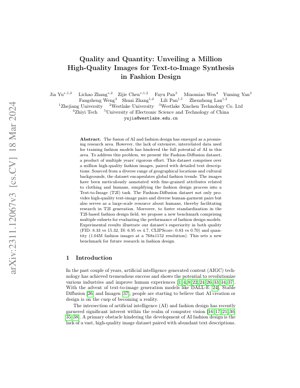
1.04M
High-Quality Fashion Images
768x1152
Image Resolution
8,037
Labeled Attributes
1.59M
Text Descriptions
1. Introduction
The fusion of Artificial Intelligence (AI) and fashion design represents a transformative frontier in computer vision and creative industries. While text-to-image (T2I) models like DALL-E, Stable Diffusion, and Imagen have demonstrated remarkable capabilities, their application in specialized domains like fashion design has been constrained by a critical bottleneck: the lack of large-scale, high-quality, and domain-specific datasets.
Existing fashion datasets, such as DeepFashion, CM-Fashion, and Prada, suffer from limitations in scale (often <100k images), resolution (e.g., 256x256), comprehensiveness (lacking full-body human figures or detailed text descriptions), or annotation granularity. This paper introduces the Fashion-Diffusion dataset, a multi-year effort to bridge this gap. It comprises over one million high-resolution (768x1152) fashion images, each paired with detailed textual descriptions covering both garment and human attributes, sourced from diverse global fashion trends.
2. The Fashion-Diffusion Dataset
2.1 Dataset Construction & Collection
Initiated in 2018, the dataset construction involved meticulous collection and curation from a vast repository of high-quality clothing images. A key differentiator is the focus on global diversity, sourcing images from varied geographical and cultural contexts to encapsulate worldwide fashion trends, not just Western-centric styles.
The pipeline combined automated and manual processes. Initial collection was followed by rigorous filtering for quality and relevance. A hybrid annotation strategy was employed, leveraging both automated subject detection/classification and manual verification by clothing design experts to ensure accuracy and detail.
2.2 Data Annotation & Attributes
In collaboration with fashion experts, the team defined a comprehensive ontology of clothing-related attributes. The final dataset includes 8,037 labeled attributes, enabling fine-grained control over the T2I generation process. Attributes cover:
- Garment Details: Category (dress, shirt, pants), style (bohemian, minimalist), fabric (silk, denim), color, pattern, neckline, sleeve length.
- Human Context: Pose, body type, gender, age group, interaction with the garment.
- Scene & Context: Occasion (casual, formal), setting.
Each image is paired with one or more high-quality text descriptions, resulting in 1.59M text-image pairs, significantly enriching the semantic alignment crucial for training T2I models.
2.3 Dataset Statistics & Features
- Scale: 1,044,491 images.
- Resolution: High-resolution 768x1152, suitable for detailed design visualization.
- Text-Image Pairs: 1,593,808 descriptions.
- Diversity: Geographically and culturally diverse sources.
- Annotation Depth: 8,037 fine-grained attributes.
- Human-Centric: Focus on full-body human figures wearing garments, not just isolated clothing items.
3. Experimental Benchmark & Results
3.1 Evaluation Metrics
The proposed benchmark evaluates T2I models on multiple axes using standard metrics:
- Fréchet Inception Distance (FID): Measures the similarity between generated and real image distributions. Lower is better.
- Inception Score (IS): Assesses the quality and diversity of generated images. Higher is better.
- CLIPScore: Evaluates the semantic alignment between generated images and input text prompts. Higher is better.
3.2 Comparative Analysis
Models trained on Fashion-Diffusion were compared against those trained on other prominent fashion datasets (e.g., DeepFashion-MM). The comparison highlights the impact of dataset quality and scale on model performance.
3.3 Results & Performance
The experimental results demonstrate the superiority of models trained on the Fashion-Diffusion dataset:
- FID: 8.33 (Fashion-Diffusion) vs. 15.32 (Baseline). A ~46% improvement, indicating generated images are significantly more photorealistic and aligned with real data.
- IS: 6.95 vs. 4.7. A ~48% improvement, reflecting better perceived image quality and diversity.
- CLIPScore: 0.83 vs. 0.70. An ~19% improvement, showing superior text-image semantic alignment.
Chart Description (Imagined): A bar chart titled "T2I Model Performance Comparison" would show three pairs of bars for FID, IS, and CLIPScore. The "Fashion-Diffusion" bars would be significantly higher (for IS, CLIPScore) or lower (for FID) than the "Baseline Dataset" bars, visually confirming the quantitative superiority reported in the text.
4. Technical Framework & Methodology
4.1 Text-to-Image Synthesis Pipeline
The research leverages diffusion models, the current state-of-the-art for T2I generation. The pipeline typically involves:
- Text Encoding: Input text prompts are encoded into a latent representation using a model like CLIP or T5.
- Diffusion Process: A U-Net architecture iteratively denoises random Gaussian noise, guided by the text embeddings, to generate a coherent image. The process is defined by a forward (noising) and reverse (denoising) Markov chain.
- Fine-Grained Control: The detailed attribute labels in Fashion-Diffusion allow for conditioning the diffusion process on specific features, enabling precise control over the generated fashion items.
4.2 Mathematical Foundation
The core of diffusion models involves learning to reverse a forward noising process. Given a data point $x_0$ (a real image), the forward process produces a sequence of increasingly noisy latents $x_1, x_2, ..., x_T$ over $T$ steps:
$q(x_t | x_{t-1}) = \mathcal{N}(x_t; \sqrt{1-\beta_t} x_{t-1}, \beta_t I)$
where $\beta_t$ is a variance schedule. The reverse process, parameterized by a neural network $\theta$, learns to denoise:
$p_\theta(x_{t-1} | x_t) = \mathcal{N}(x_{t-1}; \mu_\theta(x_t, t), \Sigma_\theta(x_t, t))$
Training involves optimizing a variational lower bound. For conditional generation (e.g., with text $y$), the model learns $p_\theta(x_{t-1} | x_t, y)$. The high-quality, well-aligned pairs in Fashion-Diffusion provide a robust training signal for learning this conditional distribution $p_\theta$ in the fashion domain.
5. Core Insights & Analyst Perspective
Core Insight:
Fashion-Diffusion isn't just another dataset; it's a strategic infrastructure play that directly attacks the primary bottleneck—data scarcity and poor quality—holding back industrial-grade AI fashion design. While the academic community has been obsessed with model architecture (e.g., refining U-Nets in diffusion models), this work correctly identifies that for a nuanced, aesthetic-driven domain like fashion, the data foundation is the real differentiator. It shifts the competitive moat from algorithms to curated, proprietary data assets.
Logical Flow:
The paper's logic is compelling: 1) Identify the problem (lack of good fashion T2I data). 2) Build the solution (a massive, high-res, well-annotated dataset). 3) Prove its value (benchmark showing SOTA results). This is a classic "if you build it, they will come" strategy for the research community. However, the flow assumes that scale and annotation quality automatically translate to better models. It somewhat glosses over potential biases introduced during their global curation process—what defines "high-quality" or "diverse" is inherently subjective and could embed cultural biases into future AI designers, a critical issue highlighted in studies of algorithmic fairness like those from the AI Now Institute.
Strengths & Flaws:
Strengths: Unprecedented scale and resolution for fashion. The inclusion of full-body human context is a masterstroke—it moves beyond generating disembodied clothing to creating wearable fashion in context, which is the real commercial need. The collaboration with domain experts for attribute definition adds crucial credibility, unlike purely web-scraped datasets.
Flaws: The paper is light on the specifics of the "hybrid" annotation process. How much was automated vs. human-labeled? What was the cost? This opacity makes it hard to assess reproducibility. Furthermore, while benchmarks show improvement, they don't demonstrate creative utility—can it generate truly novel, trend-setting designs, or does it merely interpolate existing styles? Comparing against foundational creative AI works like CycleGAN (Zhu et al., 2017), which introduced unpaired image-to-image translation, Fashion-Diffusion excels in supervised data but may lack the same potential for radical stylistic discovery that comes from unpaired, less constrained learning.
Actionable Insights:
1. For Researchers: This dataset is the new baseline. Any new fashion T2I model must be trained and evaluated on it to be taken seriously. Focus should now shift to leveraging the fine-grained attributes for controllable, explainable design rather than just improving overall FID scores.
2. For Industry (Fashion Brands): The real value lies in building upon this open-source foundation with your own proprietary data—sketches, mood boards, past collections—to fine-tune models that capture your unique brand DNA. The era of AI-assisted design is here; the winners will be those who treat AI training data as a core strategic asset.
3. For Investors: Back companies and tools that facilitate the creation, management, and labeling of high-quality domain-specific datasets. The model layer is becoming commoditized; the data layer is where defensible value is being built, as evidenced by the performance leaps shown here.
6. Application Framework & Case Study
Framework for AI-Assisted Fashion Design:
- Input: Designer provides a natural language brief (e.g., "a flowing, midi-length summer dress in lavender chiffon with puff sleeves, for a garden party") or selects specific attributes from the ontology.
- Generation: A diffusion model (e.g., a fine-tuned Stable Diffusion) trained on Fashion-Diffusion generates multiple high-resolution visual concepts.
- Refinement: The designer selects and iterates, potentially using inpainting or img2img techniques to modify specific regions (e.g., change neckline, adjust length).
- Output: Finalized design visual for prototyping or digital asset creation.
Non-Code Case Study: Trend Forecasting & Rapid Prototyping
A fast-fashion retailer wants to capitalize on an emerging trend for "cottagecore" aesthetics identified via social media analysis. Using the Fashion-Diffusion-powered T2I system, their design team inputs prompts like "cottagecore linen pinafore dress, smocked bodice, prairie aesthetic" and generates hundreds of unique design variants in hours. These are quickly reviewed, the top 10 are selected for digital sampling, and the lead times from trend identification to prototype are slashed from weeks to days, dramatically improving market responsiveness.
7. Future Applications & Directions
- Hyper-Personalized Fashion: Integrating user-specific body metrics and style preferences to generate custom-fit, personalized garment designs.
- Virtual Try-On & Metaverse Fashion: Serving as a foundational dataset for generating realistic digital clothing for avatars in virtual worlds and social platforms.
- Sustainable Design: AI-driven material optimization and zero-waste pattern generation informed by the detailed garment attributes.
- Interactive Co-Design Tools: Real-time, conversational AI design assistants where designers can iteratively refine concepts through dialogue.
- Cross-Modal Fashion Search: Enabling search for clothing items using sketches, descriptive language, or even uploaded photos of desired styles, powered by the joint text-image embedding space learned from the dataset.
- Ethical & Bias Mitigation: Future work must focus on auditing and debiasing the dataset to ensure equitable representation across body types, ethnicities, and cultures, preventing the perpetuation of fashion industry stereotypes.
8. References
- Rombach, R., Blattmann, A., Lorenz, D., Esser, P., & Ommer, B. (2022). High-Resolution Image Synthesis with Latent Diffusion Models. Proceedings of the IEEE/CVF Conference on Computer Vision and Pattern Recognition (CVPR).
- Zhu, J. Y., Park, T., Isola, P., & Efros, A. A. (2017). Unpaired Image-to-Image Translation using Cycle-Consistent Adversarial Networks. Proceedings of the IEEE International Conference on Computer Vision (ICCV).
- Liu, Z., Luo, P., Qiu, S., Wang, X., & Tang, X. (2016). DeepFashion: Powering Robust Clothes Recognition and Retrieval with Rich Annotations. Proceedings of the IEEE Conference on Computer Vision and Pattern Recognition (CVPR).
- AI Now Institute. (2019). Disability, Bias, and AI. Retrieved from https://ainowinstitute.org
- Ge, Y., Zhang, R., Wang, X., Tang, X., & Luo, P. (2021). DeepFashion-MM: A Text-to-Image Synthesis Dataset for Fashion. ACM Multimedia.
- Yu, J., Zhang, L., Chen, Z., et al. (2024). Quality and Quantity: Unveiling a Million High-Quality Images for Text-to-Image Synthesis in Fashion Design. arXiv:2311.12067v3.