Table of Contents
- 1. Introduction & Overview
- 2. The Problem: Digital Fabrication Waste
- 3. THE WASTIVE: Concept & Design
- 4. Technical & Artistic Framework
- 5. Related Work & Context
- 6. Core Insights & Analysis
- 7. Technical Details & Mathematical Model
- 8. Experimental Results & User Engagement
- 9. Analysis Framework: A Non-Code Case Study
- 10. Future Applications & Directions
- 11. References
1. Introduction & Overview
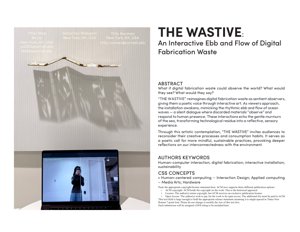
"THE WASTIVE" is an interactive art installation that poses a provocative question: What if digital fabrication waste could observe the world? It transforms discarded materials from processes like 3D printing and laser cutting into sentient observers that interact with human presence. The installation mimics the rhythmic ebb and flow of ocean waves, creating a silent, poetic dialogue between viewers and the technological residue they produce. This work sits at the intersection of Human-Computer Interaction (HCI), digital fabrication, media arts, and sustainability, aiming to foster broader public engagement with environmental issues often confined to expert communities.
2. The Problem: Digital Fabrication Waste
The democratization of digital fabrication has led to increased prototyping and material use, primarily plastics. This generates significant waste, including support structures, failed prints, and off-cuts.
2.1 Environmental Impact
Improperly disposed plastics break down into microplastics, threatening marine ecosystems. An estimated 11–23 million tons of plastic enter the ocean annually [4]. The prototyping lifecycle in HCI often overlooks the full environmental cost of material consumption.
Key Statistic
11-23 Million Tons of plastic enter the ocean each year, part of which originates from industrial and prototyping waste streams.
2.2 Current Waste Streams
Common waste includes 3D printing support structures, excess infill, failed prints, and laser-cut plywood scraps. These materials are typically seen as inert byproducts, not as entities with potential for dialogue or reflection.
3. THE WASTIVE: Concept & Design
The installation re-contextualizes waste from a problem to a participant.
3.1 Poetic Reimagination
The core concept is anthropomorphism. Waste is given a "voice" and "gaze." It shifts the perspective from "Observing 3D Printing Waste" to "Being Observed by 3D Printing Waste," challenging the viewer's role and responsibility.
3.2 Interactive Mechanism
As viewers approach, the installation awakens. Its movements and sounds are designed to mimic ocean waves—a direct metaphor for the final destination of much plastic waste. This creates a reflective, sensory experience that is both beautiful and disquieting.
4. Technical & Artistic Framework
The work blends sensor technology, kinetic sculpture, and sound design.
4.1 Sensing & Response System
Proximity sensors (e.g., ultrasonic or LiDAR) detect viewer presence and distance. This data drives actuators (likely servo or stepper motors) to create the wave-like motion in the assembled waste pieces. Audio feedback, resembling ocean murmurs, is generated algorithmically based on interaction parameters.
4.2 Material & Aesthetic Choices
The physical material is the waste itself—curated 3D-printed plastics and laser-cut wood scraps. The assembly likely follows organic, non-uniform patterns to contrast with the precise, geometric origins of the waste. The color scheme is derived from the materials' original states, with possible lighting to enhance the aquatic metaphor.
5. Related Work & Context
THE WASTIVE builds upon established research domains.
5.1 Sustainable Interaction Design (SID)
Pioneered by researchers like Blevis [1], SID advocates for integrating environmental considerations into interaction design. Eldy et al.'s sustainable prototyping lifecycle [3] provides a practical framework that THE WASTIVE complements by adding an emotional, persuasive layer.
5.2 Eco-friendly Materials Research
Initiatives like Rivera et al.'s 3D printing filament from spent coffee grounds [5] represent the material science side of sustainability. THE WASTIVE operates on the perceptual and behavioral side, aiming to change attitudes that drive demand for such innovations.
Key Insights
- Perspective Shift: Successfully reframes waste from passive object to active observer.
- Emotional Engagement: Uses art and metaphor (the ocean) to connect intellectually understood problems to visceral feeling.
- Bridging the Gap: Aims to translate expert-level sustainability concerns (SID, circular design) into public discourse through accessible experience.
6. Core Insights & Analysis
Core Insight: THE WASTIVE isn't a technical solution to waste; it's a psychological Trojan Horse. Its real innovation lies in using HCI's core strength—creating engaging experiences—to hack the user's perception of waste, making the environmental consequence of digital fabrication feel personal, immediate, and strangely beautiful.
Logical Flow: The project's logic is elegantly circular: 1) Take the physical output of a problematic system (fabrication waste). 2) Imbue it with agency using that same system's tools (sensors, actuators, code). 3) Use this agency to reflect the problem (ocean wave metaphor) back onto the system's users. It closes the feedback loop that is typically broken in disposal.
Strengths & Flaws: Its strength is its potent, non-preachy rhetoric. Unlike a statistic or a warning label, it creates empathy for the inanimate. The flaw, common in speculative design, is measurability. Does a poignant experience in a gallery translate to changed behavior in a lab or maker space? The project leans heavily on the assumption that affective engagement leads to action, a link that behavioral science often finds tenuous.
Actionable Insights: For researchers, this is a benchmark for how to make SID research compelling. The next step should be instrumenting the installation to collect data on how the experience alters viewers' stated intentions or, better yet, their subsequent prototyping choices in a linked workshop. For the industry, it's a call to view waste streams not just as logistical issues but as design material and communication channels. Imagine a 3D printer that, after a failed print, doesn't just beep but visually "sighs" with a wave-like motion of its own waste bin—a small-scale, integrated version of THE WASTIVE's principle.
7. Technical Details & Mathematical Model
The wave-like motion can be modeled as a damped harmonic system, where the waste pieces respond to viewer proximity ($d$). The activation level $A(t)$ of a given actuator could be governed by a function like:
$A(t) = A_{max} \cdot e^{-\beta d} \cdot \sin(2\pi f t + \phi) \cdot S(t)$
Where:
- $A_{max}$ is the maximum amplitude.
- $\beta$ is a damping coefficient inversely related to proximity sensitivity.
- $f$ is the frequency of the wave oscillation.
- $\phi$ is a phase offset to create traveling wave effects across multiple actuators.
- $S(t)$ is a stochastic noise function (e.g., Perlin noise) to mimic natural, non-mechanical wave variation.
The sound synthesis could use a similar parameter ($d$) to modulate the amplitude and frequency of a bank of filtered noise oscillators, creating the "gentle murmurs of the sea."
8. Experimental Results & User Engagement
While the PDF does not present formal quantitative results, the described outcome is qualitative and behavioral. The "experiment" is the installation's exhibition. Success is measured in observed viewer behavior: prolonged engagement, contemplative posture, and reported shifts in perception during post-experience interviews or comment logs. Anecdotal results likely indicate that the installation successfully triggers the intended reflection, making viewers conscious of the lifecycle of their own creative material outputs. The juxtaposition of the high-tech waste with the organic, oceanic movement is the key variable driving this reflective state.
Chart Description (Conceptual): A hypothetical bar chart comparing viewer survey responses before and after experiencing THE WASTIVE. The y-axis shows the percentage of viewers agreeing with statements like "I feel personally responsible for my prototyping waste" or "Digital fabrication waste feels like an abstract problem." A significant positive shift (increase for responsibility, decrease for abstraction) after the experience would visually demonstrate the installation's impact.
9. Analysis Framework: A Non-Code Case Study
Framework: The "Perception-Action Loop for Sustainable HCI"
Case Study Application to THE WASTIVE:
1. Obscure Perception: Normal State: Users perceive fabrication waste as an inevitable, inert byproduct ("trash"). The feedback loop between creation and environmental consequence is broken.
2. Intervention: THE WASTIVE installs itself directly into this broken loop. It physically re-presents the waste and simulates its potential environmental endpoint (the ocean) through metaphor.
3. Altered Perception: New State: Users are forced to perceive the waste as an active entity with a connection to a larger ecosystem. The loop is temporarily closed through art.
4. Potential Action: The framework hypothesizes that this altered perception increases the likelihood of sustainable actions (e.g., seeking biodegradable filaments, minimizing support material) in future fabrication tasks. This final step requires longitudinal study to validate.
This framework can be used to analyze other persuasive sustainability projects in HCI by mapping how they target specific "breaks" in the user's perception-action loop regarding resource use.
10. Future Applications & Directions
1. Educational Tool Integration: Scale-down versions of THE WASTIVE could be deployed in university maker spaces, Fab Labs, and design schools as permanent, interactive reminders, linking the creative act directly to its material consequence.
2. Generative & Adaptive Systems: Future iterations could use computer vision to analyze the specific type of waste being fed into the installation (e.g., PLA vs. ABS, support structure vs. failed print) and alter its response pattern accordingly, creating a more nuanced dialogue.
3. Data Physicalization of Waste Streams: The concept could evolve into a real-time data physicalization dashboard for a fabrication lab. The ebb and flow, color, or sound of the installation could be tied to live metrics of material consumption, energy use, or successful print rates, making resource flows tangibly visible.
4. Cross-pollination with AI Art: Integrating generative AI models (like those built on principles from CycleGAN for style transfer [7]) could allow the system to "dream" or visualize the potential future forms or degradation paths of the waste placed within it, adding a temporal dimension to the reflection.
11. References
- Blevis, E. (2007). Sustainable interaction design: invention & disposal, renewal & reuse. Proceedings of the SIGCHI Conference on Human Factors in Computing Systems (CHI '07).
- DiSalvo, C., Sengers, P., & Brynjarsdóttir, H. (2010). Mapping the landscape of sustainable HCI. Proceedings of the SIGCHI Conference on Human Factors in Computing Systems (CHI '10).
- Eldy, et al. (2023). A Sustainable Prototyping Life Cycle for Digital Fabrication. ACM Conference Paper.
- IUCN. (2021). Marine plastics. International Union for Conservation of Nature.
- Rivera, M. L., et al. (2022). Sustainable 3D Printing Filament from Spent Coffee Grounds. ACS Sustainable Chemistry & Engineering.
- Karana, E., et al. (2015). The T(r)opic of Materials: Towards a Relational Understanding of Materials Experience. International Journal of Design.
- Zhu, J., Park, T., Isola, P., & Efros, A. A. (2017). Unpaired Image-to-Image Translation using Cycle-Consistent Adversarial Networks. Proceedings of the IEEE International Conference on Computer Vision (ICCV).
- Gaver, W. (2012). What should we expect from research through design? Proceedings of the SIGCHI Conference on Human Factors in Computing Systems (CHI '12).
- IPCC. (2022). Climate Change 2022: Impacts, Adaptation and Vulnerability. Intergovernmental Panel on Climate Change.