Table of Contents
1. Introduction
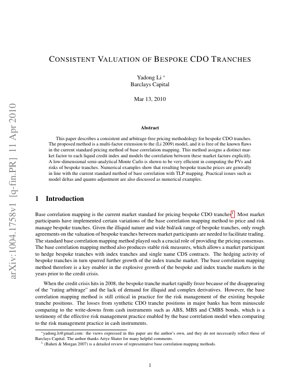
This paper addresses the critical challenge of pricing bespoke Collateralized Debt Obligation (CDO) tranches in a consistent and arbitrage-free manner. Prior to and during the 2008 financial crisis, the market standard was the base correlation mapping method. While instrumental in facilitating trading and risk management, leading to explosive market growth, this method is fundamentally flawed. It lacks pricing consistency, permits arbitrage opportunities, and can produce counter-intuitive risk measures, as documented by Morgan & Mortensen (2007). The author argues for a new methodology, extending the Li (2009) model, to price legacy positions, manage risks for standard index tranches as they age, and enable relative value trading strategies.
2. Review of Base Correlation Mapping
Base correlation mapping is a widely adopted but theoretically problematic approach. Its core limitation is the inability to produce a consistent joint distribution of default times (JDDT) or default indicators ({JDDI(t)}). This inconsistency restricts its utility primarily to interpolating portfolio loss distributions—a crucial but insufficient metric for robust pricing. The method's popularity stems from its simplicity and flexibility in constructing these distributions, which were deemed adequate during the market's growth phase. However, its flaws render it unsuitable for generating reliable hedge ratios or for consistent pricing across different tranches and portfolios.
3. The Proposed Consistent Pricing Method
The paper proposes a multi-factor extension to the Li (2009) model to overcome the deficiencies of base correlation mapping.
3.1. Multi-Factor Model Extension
The key innovation is assigning a distinct market factor to each liquid credit index (e.g., CDX, iTraxx). The correlations between these market factors are modeled explicitly. This structure naturally captures the systemic risk dependencies between different sectors or regions represented by the indices, providing a more realistic dependency framework for bespoke portfolios that may span multiple benchmarks.
3.2. Model Formulation and Key Equations
The model posits that the default time $\tau_i$ of a single name is driven by a combination of systematic market factors $M_k$ and an idiosyncratic factor $\epsilon_i$. A firm's asset value $A_i(t)$ is modeled as: $$A_i(t) = \sum_{k} \beta_{i,k} M_k(t) + \sqrt{1 - \sum_{k} \beta_{i,k}^2} \, \epsilon_i(t)$$ where $\beta_{i,k}$ represents the loading of firm $i$ on market factor $k$. Default occurs when $A_i(t)$ falls below a predetermined barrier $B_i(t)$, derived from the firm's hazard rate. The joint distribution of defaults is thus determined by the correlation structure of the market factors $\rho_{k,l} = \text{Corr}(M_k, M_l)$ and the individual firm loadings.
4. Numerical Results and Practical Implementation
4.1. Pricing Comparison with TLP Mapping
Numerical tests indicate that the proposed model produces bespoke tranche prices generally aligned with those from the standard base correlation method using Tranche Loss Percentage (TLP) mapping. This is a pragmatic result, suggesting the model can serve as a drop-in replacement without causing major market value dislocations for existing books.
4.2. Risk Measures: Tranche and Single Name Deltas
A significant advantage is the generation of stable and intuitive risk measures. The model computes tranche deltas (sensitivity to the index) and single-name deltas (sensitivity to individual credit spreads) within a consistent framework. This allows for more effective hedging strategies compared to the unstable deltas sometimes produced by base correlation.
4.3. Quanto Adjustment Discussion
The paper touches on quanto adjustments, which are necessary when the premium and default payments of a tranche are denominated in different currencies. The model's explicit factor structure provides a clearer foundation for calculating these adjustments compared to the ad-hoc methods often used with base correlation.
5. Core Insight & Analyst's Perspective
Core Insight: Li's paper is a surgical strike on the complacency that settled over the CDO market post-crisis. It correctly identifies that the industry's continued reliance on base correlation mapping—a tool known to be broken—is a ticking time bomb for risk management, not just a theoretical curiosity. The core insight isn't just the multi-factor model itself, but the explicit admission that pricing models must generate a consistent joint distribution of defaults to be useful for anything beyond rough, consensus-driven trading. This aligns with foundational work in asset pricing theory, such as the requirement for no-arbitrage conditions as formalized in the fundamental theorem of asset pricing (Delbaen & Schachermayer, 1994). A model that violates this, like base correlation mapping, is fundamentally unfit for calculating hedge ratios or marking complex books to model.
Logical Flow: The argument is compelling and follows a clean, practitioner-oriented logic: (1) Here's the standard tool (base correlation). (2) Here's why it's fundamentally flawed (no consistent JDDT, arbitrage). (3) Here's what we need for real risk management (consistent JDDT, stable Greeks). (4) Here's my solution (multi-factor extension of Li 2009). (5) Here's proof it works and doesn't break existing marks. This flow mirrors the problem-solution-validation structure seen in influential quantitative finance papers, such as the original Local Volatility model by Dupire (1994), which also sought to correct a market-standard but inconsistent practice (using constant implied volatility).
Strengths & Flaws: The model's strength is its pragmatic design. By tying factors to liquid indices, it grounds the model in observable market variables, enhancing calibration and hedgability. The use of semi-analytical Monte Carlo is a smart efficiency trade-off. However, the paper's major flaw is its timing and scope. Published in 2010, it arrives as the bespoke CDO market is in ruins. Its "future" is managing a legacy book in runoff, a crucial but diminishing task. It sidesteps the elephant in the room: the non-normality of defaults and the inadequacy of Gaussian copula-based approaches (even multi-factor ones) during systemic crises, a flaw brutally exposed in 2008. Models like the one by Hull and White (2004) or the more recent use of forward-intensity models have argued for more dynamic, spread-based approaches to capture clustering risk better.
Actionable Insights: For quants at banks with legacy structured credit books, this paper is a mandatory blueprint. The immediate action is to run a model comparison: re-price a sample of bespoke tranches under both base correlation and this multi-factor model. The key is not the PV difference, but the divergence in deltas—this is where hidden risk lies. For regulators, the insight is to mandate that capital calculations for complex derivatives be based on models that explicitly preclude arbitrage and generate consistent risk metrics. For the academic community, the paper points to a fertile area: developing fast, arbitrage-free models for portfolio credit products that can handle the non-linear, clustered default behavior that simple factor models miss. The future lies in hybrid models that marry this paper's consistency with the crisis dynamics captured by more recent research.
6. Technical Details and Mathematical Framework
The model's engine is a semi-analytical Monte Carlo simulation. The steps are:
- Factor Simulation: For each simulation path $j$, generate correlated market factor returns $M_k^j$ from a multivariate normal distribution: $\mathbf{M}^j \sim N(\mathbf{0}, \mathbf{\Sigma})$, where $\mathbf{\Sigma}$ is the factor correlation matrix.
- Firm Value Calculation: For each firm $i$, compute its asset value: $A_i^j = \sum_k \beta_{i,k} M_k^j + \sqrt{1 - \sum_k \beta_{i,k}^2} \, \epsilon_i^j$, with $\epsilon_i^j \sim N(0,1)$ i.i.d.
- Default Check: Determine if firm $i$ defaults in time period $[t, t+\Delta t]$ by checking if $A_i^j < \Phi^{-1}(PD_i(t))$, where $PD_i(t)$ is the cumulative risk-neutral default probability derived from its CDS spread, and $\Phi$ is the standard normal CDF.
- Portfolio Loss Aggregation: Sum losses from defaulted entities, applying relevant recovery rates, to get the portfolio loss path $L^j(t)$.
- Tranche PV Calculation: For a tranche with attachment point $A$ and detachment point $D$, the loss is $L_{\text{tranche}}^j(t) = \min(\max(L^j(t)-A, 0), D-A)$. The present value is the discounted expectation of premium and loss legs across all paths.
7. Experimental Results and Chart Analysis
The paper presents numerical examples, though specific charts are not reproduced in the provided excerpt. Based on the description, we can infer the key results:
- Chart 1: Price Comparison Surface. This would likely be a 3D plot or heat map showing the price (or spread) of bespoke tranches across different attachment points (x-axis) and maturities (y-axis), comparing the proposed model (Model Z) against the standard Base Correlation with TLP mapping (Market Std). The surfaces would be largely congruent, with minor deviations, especially for senior tranches or non-standard portfolios, demonstrating the model's market compatibility.
- Chart 2: Delta Profile Comparison. A line chart plotting tranche delta (sensitivity to the index) against attachment point. The line for the proposed model would be smooth and monotonic. The line for base correlation might show non-monotonic "wavy" or discontinuous behavior, particularly around the standard index detachment points (3%, 7%, 10%, 15%, 30%), highlighting the unstable hedging signals of the old method.
- Chart 3: Single-Name Delta Distribution. A histogram showing the distribution of single-name deltas for constituents of a bespoke portfolio. The proposed model would produce a tighter, more logical distribution centered around intuitive values based on subordination and correlation. Base correlation might produce a bi-modal or overly dispersed distribution, including negative deltas for some names in equity tranches—a counter-intuitive result.
8. Analysis Framework: A Practical Case Study
Scenario: A risk manager holds a legacy bespoke tranche referencing a portfolio of 100 North American corporates. The tranche is A-rated, with attachment at 12% and detachment at 22%. The portfolio has overlaps with the CDX.NA.IG index but is not identical.
Framework Application:
- Calibration: Calibrate the multi-factor model. The primary market factor is mapped to CDX.NA.IG. Loadings ($\beta_{i,k}$) for names in the index are calibrated to match index tranche prices. For bespoke names not in the index, loadings are assigned based on sector/rating proxies or statistical analysis.
- Valuation & Benchmarking: Price the bespoke tranche using the calibrated model. Simultaneously, price it using the desk's standard base correlation/TLP mapping tool. Compare the PVs. Assume they are within the bid-ask spread (e.g., Model: 245 bps, BaseCorr: 250 bps).
- Risk Analysis (The Critical Step): Calculate the tranche's delta to the CDX.NA.IG 12-22% index tranche under both models.
- Base Correlation Model Delta: 0.85 (but highly sensitive to small changes in input correlation, jumping to 1.1 or 0.7 with minor perturbations).
- Proposed Model Delta: 0.88, with stable sensitivity to input changes.
- Action: The risk manager decides to use the proposed model's delta (0.88) to determine the notional of CDX.NA.IG 12-22% tranche to buy/sell for hedging. The desk's P&L attribution system is updated to monitor the hedge effectiveness based on this new, more stable metric.
9. Future Applications and Development Directions
The principles outlined have relevance beyond legacy bespoke CDOs:
- Standardization of Non-Standard Risks: The explicit factor approach can be applied to price and risk-manage bespoke tranches on new asset classes like CLOs (Collateralized Loan Obligations), where a "standard" index factor (e.g., a leveraged loan index) can be used.
- XVA Framework Integration: Consistent joint default distributions are critical for calculating Credit Valuation Adjustment (CVA), Debt Valuation Adjustment (DVA), and Funding Valuation Adjustment (FVA). This model provides a coherent framework for simulating counterparty defaults and collateral calls within portfolio credit contexts.
- Stress Testing and Scenario Analysis: Regulators demand severe but plausible stress scenarios. The multi-factor model allows for clean, interpretable shocks to specific market factors (e.g., "shock the European factor by 3 standard deviations while keeping the US factor constant") to assess portfolio resilience.
- Machine Learning Enhancement: Future work could involve using machine learning techniques to calibrate the factor loadings ($\beta_{i,k}$) and inter-factor correlations ($\mathbf{\Sigma}$) from high-dimensional datasets of CDS spreads and equity returns, moving beyond simple sector/rating proxies.
- Integration with Default Clustering Models: The next evolution would be to replace the Gaussian copula foundation with a dynamic intensity-based or Hawkes process-based framework that inherently captures default clustering, while retaining the consistent, multi-factor, arbitrage-free pricing architecture proposed here.
10. References
- Baheti, P., & Morgan, S. (2007). Base Correlation Mapping. Merrill Lynch.
- Delbaen, F., & Schachermayer, W. (1994). A General Version of the Fundamental Theorem of Asset Pricing. Mathematische Annalen, 300(1), 463–520.
- Dupire, B. (1994). Pricing with a Smile. Risk Magazine, 7(1), 18–20.
- Hull, J., & White, A. (2004). Valuation of a CDO and an nth to Default CDS Without Monte Carlo Simulation. Journal of Derivatives, 12(2), 8–23.
- Li, Y. (2009). [Reference to Li 2009 model].
- Morgan, S., & Mortensen, A. (2007). CDO Mapping Algorithms. Lehman Brothers.
- Gregory, J. (2010). Counterparty Credit Risk: The New Challenge for Global Financial Markets. Wiley Finance. (For XVA context).
- Giesecke, K., & Goldberg, L. R. (2004). Forecasting Default in the Face of Uncertainty. The Journal of Derivatives, 12(1), 14–25. (For intensity models).